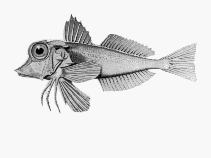
Environment: milieu / climate zone / rango de profundidad / distribution range
Ecología
marino demersal; rango de profundidad 10 - 300 m (Ref. 33616). Temperate; 25°S - 43°S
Eastern Indian Ocean: southern Australia, from Western Australia to New South Wales, including Tasmania.
Tamaño / Peso / Age
Madurez: Lm ? range ? - ? cm
Max length : 22.0 cm SL macho / no sexado; (Ref. 33616)
Short description
Claves de identificación | Morfología | Morfometría
Espinas dorsales (total) : 9; Radios blandos dorsales (total) : 15 - 16; Espinas anales: 0; Radios blandos anales: 16 - 17; Vértebra: 31.
Occur on coastal waters, in the continental shelf area (Ref. 33616).
Life cycle and mating behavior
Madurez | Reproducción | Puesta | Huevos | Fecundidad | Larva
Neira, F.J., A.G. Miskiewicz and T. Trnski, 1998. Larvae of temperate Australian fishes: laboratory guide for larval fish identification. University of Western Australia Press. 474 p. (Ref. 33616)
IUCN Red List Status (Ref. 130435: Version 2025-1)
Threat to humans
Harmless
Human uses
Pesquerías: sin interés
Herramientas
Special reports
Download XML
Fuentes de Internet
Estimates based on models
Preferred temperature (Referencia
123201): 14 - 19.8, mean 16 °C (based on 139 cells).
Phylogenetic diversity index (Referencia
82804): PD
50 = 0.5000 [Uniqueness, from 0.5 = low to 2.0 = high].
Bayesian length-weight: a=0.00676 (0.00325 - 0.01404), b=3.05 (2.87 - 3.23), in cm total length, based on LWR estimates for this (Sub)family-body shape (Ref.
93245).
Nivel trófico (Referencia
69278): 3.5 ±0.3 se; based on size and trophs of closest relatives
Resiliencia (Referencia
120179): Medio, población duplicada en un tiempo mínimo de 1.4-4.4 años (Preliminary K or Fecundity.).
Fishing Vulnerability (Ref.
59153): Low vulnerability (17 of 100).
🛈