Teleostei (teleosts) >
Clupeiformes (Herrings) >
Clupeidae (Herrings, shads, sardines, menhadens)
Etymology: Hyperlophus: Greek, hyper = over + Greek, lophos = crest (Ref. 45335).
More on author: Castelnau.
Environment: milieu / climate zone / depth range / distribution range
Ecology
Marine; brackish; pelagic-neritic; amphidromous (Ref. 51243); depth range 10 - 13 m. Temperate; 25°S - 40°S, 112°E - 155°E (Ref. 188)
Western Pacific: southern Australia, from Kalbarri, Western Australia to South Australia, New South Wales and Moreton Bay, Queensland.
Size / Weight / Age
Maturity: Lm ? range ? - ? cm
Max length : 10.0 cm SL male/unsexed; (Ref. 188)
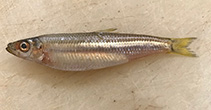
Dorsal spines (total): 0; Dorsal soft rays (total): 12 - 18; Anal spines: 0; Anal soft rays: 16 - 27. Body fairly elongate, belly keeled, with 19 to 24 - 10 to 13 scutes; 23 to 27 dorsal scutes with low keels from head to dorsal fin origin. Second supra-maxilla paddle-shaped, lower portion larger. Branchiostegal rays 4. Anal fin origin an eye diameter or more behind base of last dorsal fin ray. Scales more or less firm on body; a silvery band along flank.
Body shape (shape guide): elongated.
Schools in large numbers in shallow sandy areas of bays and estuaries.
Life cycle and mating behavior
Maturity | Reproduction | Spawning | Eggs | Fecundity | Larvae
Whitehead, P.J.P., 1985. FAO Species Catalogue. Vol. 7. Clupeoid fishes of the world (suborder Clupeoidei). An annotated and illustrated catalogue of the herrings, sardines, pilchards, sprats, shads, anchovies and wolf-herrings. FAO Fish. Synop. 125(7/1):1-303. Rome: FAO. (Ref. 188)
IUCN Red List Status (Ref. 130435: Version 2025-2)
Threat to humans
Harmless
Human uses
Fisheries: subsistence fisheries; bait: usually
Tools
Special reports
Download XML
Internet sources