>
Blenniiformes (Blennies) >
Blenniidae (Combtooth blennies) > Salariinae
Etymology: Parablennius: Greek, para = the side of + Greek, blennios = mucus (Ref. 45335).
More on author: Pallas.
Environment: milieu / Zona climática / intervalo de profundidade / distribution range
Ecologia
marinhas demersal; não migratória; intervalo de profundidade 0 - 1 m. Subtropical; 47°N - 9°N, 32°W - 42°E
Eastern Atlantic: Loire, France to Morocco including the Mediterranean and Black Sea.
Tamanho / Peso / Idade
Maturidade: Lm ? range ? - ? cm
Max length : 20.0 cm TL macho/indeterminado; (Ref. 3397); common length : 12.5 cm TL macho/indeterminado; (Ref. 3397)
Espinhos dorsais (total) : 11; Raios dorsais (total) : 21; Espinhos anais: 0; Raios anais : 21.
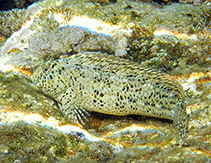
Body shape (shape guide): fusiform / normal.
Facultative air-breathing in the genus (Ref. 126274); Are residents in intertidal areas with homing behavior (Ref. 32612). They are found between pebbles or at margins of steep, filamentous algae-covered rocks exposed to sunlight. They make underwater 'flight' over long distances. Feed almost exclusively on algae (Ref. 205), favoring the algae Ulva (Ref. 94105). Spawns from May to July. Oviparous. Eggs are demersal and adhesive (Ref. 205), and are attached to the substrate via a filamentous, adhesive pad or pedestal (Ref. 94114). Larvae are planktonic, often found in shallow, coastal waters (Ref. 94114).
Ciclo de vida ou comportamento de acasalamento
Maturidade | Reprodução | Desova | Ovos | Fecundidade | Larvas
Oviparous, distinct pairing (Ref. 205).
Zander, C.D., 1986. Blenniidae. p. 1096-1112. In P.J.P. Whitehead, M.-L. Bauchot, J.-C. Hureau, J. Nielsen and E. Tortonese (eds.) Fishes of the North-eastern Atlantic and the Mediterranean, volume 3. UNESCO, Paris. (Ref. 5981)
Status na Lista Vermelha da UICN (Ref. 130435: Version 2025-1)
Ameaça para os humanos
Harmless
Uso pelos humanos
Pescarias: pouco comercial; Aquário: Espécies comerciais
Ferramentas
Relatórios especiais
Baixar XML
Fontes da internet
Estimates based on models
Preferred temperature (Ref.
123201): 15.1 - 20.4, mean 18.6 °C (based on 485 cells).
Índice de diversidade filogenética (Ref.
82804): PD
50 = 0.5000 [Uniqueness, from 0.5 = low to 2.0 = high].
Bayesian length-weight: a=0.01230 (0.00919 - 0.01647), b=3.00 (2.94 - 3.06), in cm total length, based on LWR estimates for this species (Ref.
93245).
Nível Trófico (Ref.
69278): 2.1 ±0.0 se; based on diet studies.
Resiliência (Ref.
120179): médio(a), tempo mínimo de duplicação da população 1,4 - 4,4 anos (Preliminary K or Fecundity.).
Fishing Vulnerability (Ref.
59153): Low vulnerability (10 of 100).
🛈
Nutrients (Ref.
124155): Calcium = 179 [81, 438] mg/100g; Iron = 1.39 [0.76, 2.73] mg/100g; Protein = 18.6 [17.4, 19.9] %; Omega3 = 0.218 [0.103, 0.459] g/100g; Selenium = 9.41 [4.21, 24.25] μg/100g; VitaminA = 16.9 [4.0, 68.2] μg/100g; Zinc = 1.47 [0.95, 2.33] mg/100g (wet weight);