>
Pleuronectiformes (Flatfishes) >
Bothidae (Lefteye flounders)
Etymology: Engyprosopon: Greek, eggys = nearly + Greek,prosopon = a face (Ref. 45335).
Environment: milieu / climate zone / ระดับความลึก / distribution range
นิเวศวิทยา
เกี่ยวกับทะเล,น้ำเค็ม สัตว์น้ำหน้าดิน; ระดับความลึก 50 - 100 m (Ref. 126076). Temperate
Northwest Pacific: Japan to Taiwan.
ขนาด / น้ำหนัก / Age
วัยเจริญพันธุ์: Lm ? range ? - ? cm
Max length : 10.6 cm SL เพศผู้/กระเทย; (Ref. 33837)
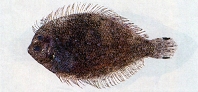
เงี่ยงครีบหลัง (รวม) : 0; ก้านครีบอ่อนที่หาง (รวม) : 83 - 96; เงี่ยงครีบก้น: 0; ก้านครีบอ่อนที่ก้น: 62 - 73. A pair of jet-black blotches on caudal fin between the 2nd and 4th rays counted from above and below respectively. Body narrow, its depth less than 1/2 of SL. Pectoral fin long, upper rays elongated into filaments, its length longer than head length. More scales in lateral line and more pectoral fin rays than in E. grandisquama.
Body shape (shape guide): short and / or deep; Cross section: compressed.
Amaoka, K. and H.-C. Ho, 2018. Review of the genus Engyprosopon Günther, 1862 (Pleuronectiformes: Bothidae) from waters off Taiwan, with descriptions of two new species. Zootaxa 4413(3):449-481. (Ref. 126076)
IUCN Red List Status (Ref. 130435: Version 2025-1)
Threat to humans
Harmless
Human uses
เครื่องมือ
Special reports
Download XML
แหล่งที่มาจากอินเตอร์เน็ต
Estimates based on models
Phylogenetic diversity index (อ้างอิง
82804): PD
50 = 0.5000 [Uniqueness, from 0.5 = low to 2.0 = high].
Bayesian length-weight: a=0.00871 (0.00461 - 0.01646), b=3.06 (2.90 - 3.22), in cm total length, based on LWR estimates for this species & (Sub)family-body (Ref.
93245).
ระดับชั้นอาหาร (อ้างอิง
69278): 3.5 ±0.4 se; based on size and trophs of closest relatives
ความสามารถในการกลับคืนสู่ปกติ (อ้างอิง
120179): ขนาดกลาง, เวลาต่ำสุดที่จะทำให้ประชากรเพิ่มขึ้นเป็น 2 เท่าใช้เวลา 1.4 - 4.4 ปี (Preliminary K or Fecundity.).
Fishing Vulnerability (Ref.
59153): Low vulnerability (10 of 100).
🛈