



Add your observation in Fish Watcher
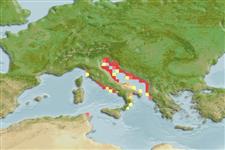
| Native range | All suitable habitat | Point map | Year 2050 |
|
| This map was computer-generated and has not yet been reviewed. |
| Acipenser naccarii AquaMaps Data sources: GBIF OBIS |
Upload your photos and videos
Pictures | Google image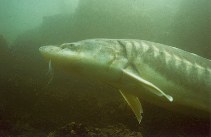 Acipenser naccarii
Picture by Andreoli, R.
Pictures | Google image
Picture by Andreoli, R.
Classification / Names Common names | Synonyms | Catalog of Fishes(genus, species) | ITIS | CoL | WoRMS | Cloffa
Chondrostei (sturgeons) > Acipenseriformes (Sturgeons and paddlefishes) > Acipenseridae (Sturgeons)
Etymology: Acipenser: Latin, acipenser = sturgeon, 1853 (Ref. 45335).
Eponymy: Fortunato Luigi Naccari (1793–1860) was an Italian philosopher, librarian and professor of natural history. [...] (Ref. 128868), visit book page.
More on author: Bonaparte.
Etymology: Acipenser: Latin, acipenser = sturgeon, 1853 (Ref. 45335).
Eponymy: Fortunato Luigi Naccari (1793–1860) was an Italian philosopher, librarian and professor of natural history. [...] (Ref. 128868), visit book page.
More on author: Bonaparte.
Environment: milieu / climate zone / depth range / distribution range Ecology
Marine; freshwater; brackish; demersal; anadromous (Ref. 138126); depth range 10 - 40 m (Ref. 93286). Temperate; 46°N - 37°N, 10°E - 20°E
Distribution Territories | FAO areas | Ecosystems | Occurrences | Point map | Introductions | Faunafri
Europe: Adriatic Sea and its tributaries between Po (Italy) and Buna (Albania) drainages. Recorded from Corfu; present in lowermost part of Adriatic rivers from Soca to Drin. Records from Tyrrhenian slope of Italy, Spain and France are erroneous.
Size / Weight / Age
Maturity: Lm ? range ? - ? cm
Max length : 200 cm TL male/unsexed; (Ref. 3397); max. published weight: 25.0 kg (Ref. 3193)
Max length : 200 cm TL male/unsexed; (Ref. 3397); max. published weight: 25.0 kg (Ref. 3193)
Short description Identification keys | Morphology | Morphometrics
Dorsal spines (total): 0; Dorsal soft rays (total): 36 - 48; Anal soft rays: 24 - 31. Snout moderate, very broad and rounded at tip. Lower lip continuous, interrupted at center. Barbels nearer to tip of snout than to mouth and not touching it. Five rows of scutes, dorsal 10-14 (the middle ones deeper and usually larger than those at front), lateral 32-42 on each side, ventral 8-11 on each side, with no smaller plates between dorsal and lateral rows. Back is olivaceous brown, flanks lighter, belly white.
Body shape (shape guide): elongated; Cross section: circular.
Body shape (shape guide): elongated; Cross section: circular.
Occurs in the sea close to shore and estuaries, not entering pure marine waters. In freshwater, it inhabits large deep rivers (Ref. 59043). A long-lived species which is found mainly over sand and mud. Feeds on bottom-living invertebrates and small fishes. Reproduction takes place from May to July. Is threatened by habitat destruction, pollution and overfishing (Ref. 26100). The flesh is used for food (Ref. 6866) and eggs used for caviar production (Ref. 128183).
Life cycle and mating behavior Maturity | Reproduction | Spawning | Eggs | Fecundity | Larvae
Enters rivers from March to May, and presumably spawns then.
Main reference
Upload your references | References | Coordinator | Collaborators
Kottelat, M. and J. Freyhof, 2007. Handbook of European freshwater fishes. Publications Kottelat, Cornol and Freyhof, Berlin. 646 pp. (Ref. 59043)
IUCN Red List Status (Ref. 130435: Version 2025-2 (Global))
Critically Endangered (CR) (A2bcde); Date assessed: 14 September 2019
Threat to humans
Harmless
Human uses
Fisheries: commercial
FAO - Aquaculture systems: production; Fisheries: species profile; Publication: search | FishSource |
More information
Population dynamics
Growth parameters
Max. ages / sizes
Length-weight rel.
Length-length rel.
Length-frequencies
Mass conversion
Recruitment
Abundance
Growth parameters
Max. ages / sizes
Length-weight rel.
Length-length rel.
Length-frequencies
Mass conversion
Recruitment
Abundance
Life cycle
Reproduction
Maturity
Maturity/Gills rel.
Fecundity
Spawning
Spawning aggregations
Eggs
Egg development
Larvae
Larval dynamics
Reproduction
Maturity
Maturity/Gills rel.
Fecundity
Spawning
Spawning aggregations
Eggs
Egg development
Larvae
Larval dynamics
Anatomy
Gill area
Brain
Otolith
Gill area
Brain
Otolith
Physiology
Body composition
Nutrients
Oxygen consumption
Swimming type
Swimming speed
Visual pigments
Fish sound
Diseases & Parasites
Toxicity (LC50s)
Body composition
Nutrients
Oxygen consumption
Swimming type
Swimming speed
Visual pigments
Fish sound
Diseases & Parasites
Toxicity (LC50s)
Human related
Aquaculture systems
Aquaculture profiles
Strains
Ciguatera cases
Stamps, coins, misc.
Aquaculture systems
Aquaculture profiles
Strains
Ciguatera cases
Stamps, coins, misc.
Tools
Bio-Quiz | E-book | Field guide | Identification keys | Length-frequency wizard | Life-history tool | Point map |
Catch-MSY |
Special reports
Download XML
Internet sources
AFORO (otoliths) | Alien/Invasive Species database | Aquatic Commons | BHL | Cloffa | Websites from users | Check FishWatcher | CISTI | Catalog of Fishes: genus, species | DiscoverLife | ECOTOX | FAO - Aquaculture systems: production; Fisheries: species profile; Publication: search | Faunafri | Fishipedia | Fishtrace | GloBI | Google Books | Google Scholar | Google | IGFA World Record | National databases | OneZoom | Open Tree of Life | Otolith Atlas of Taiwan Fishes | PubMed | Reef Life Survey | Socotra Atlas | TreeBase | Tree of Life | Wikipedia: Go, Search | World Records Freshwater Fishing | Zoobank | Zoological Record
Estimates based on models
Preferred temperature (Ref. 123201): 14.7 - 18.2, mean 17.4 °C (based on 12 cells).
Phylogenetic diversity index (Ref. 82804): PD50 = 0.5000 [Uniqueness, from 0.5 = low to 2.0 = high].
Bayesian length-weight: a=0.00295 (0.00132 - 0.00659), b=3.18 (3.00 - 3.36), in cm total length, based on LWR estimates for this Genus-body shape (Ref. 93245).
Trophic level (Ref. 69278): 3.4 ±0.50 se; based on food items.
Resilience (Ref. 120179): Very Low, minimum population doubling time more than 14 years (tm=6-12).
Nutrients (Ref. 124155): Calcium = 16.9 [10.0, 29.8] mg/100g; Iron = 0.256 [0.156, 0.410] mg/100g; Protein = 17.5 [14.9, 20.1] %; Omega3 = 0.33 [0.18, 0.59] g/100g; Selenium = 18.3 [9.3, 35.5] μg/100g; VitaminA = 6.4 [2.3, 17.8] μg/100g; Zinc = 0.53 [0.38, 0.73] mg/100g (wet weight);