Teleostei (teleosts) >
Gobiesociformes (Clingfishes) >
Gobiesocidae (Clingfishes and singleslits) > Gobiesocinae
Etymology: Rimicola: Latin, rima, -ae = crack, cleft + Latin, colere = to live.
More on authors: Meek & Pierson.
Environment: milieu / climate zone / depth range / distribution range
Ecology
Marine; demersal. Subtropical; 55°N -
Eastern Pacific: Queen Charlotte Islands, British Columbia, Canada to Bahia Todos Santos, southern Baja California, Mexico (Ref. 27436).
Size / Weight / Age
Maturity: Lm ? range ? - ? cm
Max length : 7.0 cm TL male/unsexed; (Ref. 2850)
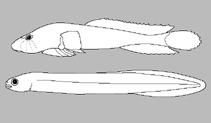
Dorsal spines (total): 0; Dorsal soft rays (total): 6 - 8; Anal spines: 0; Anal soft rays: 6 - 8. First 1 or 2 rays of dorsal fin embedded; caudal roundish, narrow; pelvic fins united anteriorly by wrinkled membrane to form the anterior portion of small adhesive disc which is completed posteriorly by a broad fold of skin from the ventral surface of body, the anterior and posterior segments of the disc separated by lateral clefts (Ref. 6885). Color light olive green to brown; females sometimes sparsely covered with distinct brownish red spots about the size of the pupil of the eye (Ref. 6885).
Body shape (shape guide): elongated.
Clings to strands of kelp (often high in kelp canopy) or eelgrass with its disk; moves to seek food or cover. Rarely found in tide pools.
Life cycle and mating behavior
Maturity | Reproduction | Spawning | Eggs | Fecundity | Larvae
Eschmeyer, W.N., E.S. Herald and H. Hammann, 1983. A field guide to Pacific coast fishes of North America. Boston (MA, USA): Houghton Mifflin Company. xii+336 p. (Ref. 2850)
IUCN Red List Status (Ref. 130435: Version 2025-2)
Threat to humans
Harmless
Human uses
Tools
Special reports
Download XML
Internet sources