Teleostei (teleosts) >
Gadiformes (Cods) >
Phycidae (Phycid hakes)
Etymology: Urophycis: Greek, oura = tail + Greek, phyke, pykis, -idos = the female of a fish that lives among algae (Greek = phykon), related with the gudgeon (Ref. 45335).
More on author: Kaup.
Environment: milieu / climate zone / depth range / distribution range
Ecology
Marine; demersal; non-migratory; depth range 24 - 190 m. Subtropical; 21°S - 46°S, 68°W - 41°W
Southwest Atlantic: southern Brazil, Uruguay, Argentina and Falkland Is.
Size / Weight / Age
Maturity: Lm ? range ? - ? cm
Max length : 58.6 cm TL male/unsexed; (Ref. 39376); common length : 25.0 cm TL male/unsexed; (Ref. 6077)
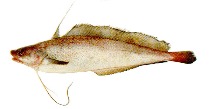
Dorsal spines (total): 0; Dorsal soft rays (total): 62 - 69; Anal spines: 0; Anal soft rays: 43 - 46. Body elongated; head small; eyes small. First dorsal-fin ray elongated; pelvic fins extending beyond the origin of the anal fin. Mottled pattern on back and upper sides.
Body shape (shape guide): fusiform / normal; Cross section: circular.
Life cycle and mating behavior
Maturity | Reproduction | Spawning | Eggs | Fecundity | Larvae
Cohen, D.M., T. Inada, T. Iwamoto and N. Scialabba, 1990. FAO species catalogue. Vol. 10. Gadiform fishes of the world (Order Gadiformes). An annotated and illustrated catalogue of cods, hakes, grenadiers and other gadiform fishes known to date. FAO Fish. Synop. 125(10). Rome: FAO. 442 p. (Ref. 1371)
IUCN Red List Status (Ref. 130435: Version 2025-2)
Threat to humans
Harmless
Human uses
Fisheries: commercial
Tools
Special reports
Download XML
Internet sources