Teleostei (teleosts) >
Ophidiiformes (Cusk eels) >
Ophidiidae (Cusk-eels) > Ophidiinae
Etymology: Ophidion: Diminutive of Greek, ophis = serpent (Ref. 45335).
Eponymy: Dr John Edwards Holbrook (1794–1871) was a zoologist and herpetologist who has been described as ‘the Father of North American Herpetology’. [...] (Ref. 128868), visit book page.
Environment: milieu / climate zone / depth range / distribution range
Ecology
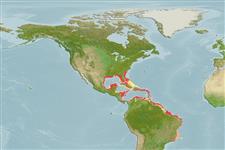
Marine; reef-associated; depth range 0 - 75 m (Ref. 5217), usually 18 - ? m (Ref. 51183). Tropical; 33°N - 23°S, 98°W - 34°W (Ref. 34024)
Western Atlantic: North Carolina, USA and northern Gulf of Mexico to southeastern Brazil. Absent from the Bahamas.
Size / Weight / Age
Maturity: Lm ? range ? - ? cm
Max length : 30.0 cm TL male/unsexed; (Ref. 7251); common length : 23.0 cm TL male/unsexed; (Ref. 5217)
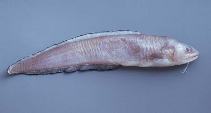
Head and body tan, unmarked except for dark margin to dorsal fin and, occasionally, anal fin; gill raker on first arch with 2 rudiments on upper limb; dorsal profile nearly straight from snout to dorsal-fin origin (not arched); body distinctly deepest at dorsal-fin origin; body slab-sided (Ref. 34024).
Body shape (shape guide): elongated.
A common species ranging from coastal bays to 75 m depth (Ref. 34024). Inhabit soft bottoms (Ref. 5217). Oviparous, with oval pelagic eggs floating in a gelatinous mass (Ref. 205). Flesh is appreciated (Ref. 5217).
Life cycle and mating behavior
Maturity | Reproduction | Spawning | Eggs | Fecundity | Larvae
Nielsen, J.G., D.M. Cohen, D.F. Markle and C.R. Robins, 1999. Ophidiiform fishes of the world (Order Ophidiiformes). An annotated and illustrated catalogue of pearlfishes, cusk-eels, brotulas and other ophidiiform fishes known to date. FAO Fish. Synop. 125(18):178p. Rome: FAO. (Ref. 34024)
IUCN Red List Status (Ref. 130435: Version 2025-2)
Threat to humans
Harmless
Human uses
Fisheries: minor commercial
Tools
Special reports
Download XML
Internet sources