Environment: milieu / climate zone / пределы глубины / distribution range
экология
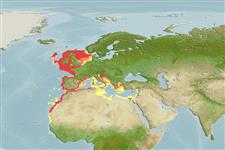
морской демерсальный; пределы глубины 20 - 400 m (Ref. 35388). Subtropical; 60°N - 15°N, 18°W - 36°E
Northeast Atlantic: British Isles south to Senegal (baie du Lévrier) and the Mediterranean.
Length at first maturity / Size / Вес / Возраст
половая зрелость: Lm ?, range 14 - ? cm
Max length : 35.0 cm SL самец/пол неопределен; (Ref. 35388); common length : 14.0 cm TL самец/пол неопределен; (Ref. 3397); наибольший возраст (опубликованны данные): 14 годы (Ref. 32766)
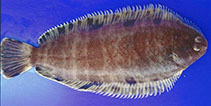
колючие лучи спинного плавника (общее число) : 0; членистые (мягкие) лучи спинного плавника (общее число) : 0. Upper eye less than its own diameter from dorsal profile of head. Anterior nostril on blind side not enlarged, its distance from front margin of head about twice in its distance from cleft of mouth. Anterior nostril on eyed side with backward-pointing tube reaching to front border of lower eye. Pectoral fin on eyed-side small, on blind side reduced.
Body shape (shape guide): short and / or deep; Cross section: compressed.
Inhabits mud or sand bottoms. Feeds on a wide range of small bottom-living organisms, mainly crustaceans (amphipods, shrimps), also polychaete worms and bivalve mollusks (Ref. 4710). Utilized as a food fish.
Robins, C.R., R.M. Bailey, C.E. Bond, J.R. Brooker, E.A. Lachner, R.N. Lea and W.B. Scott, 1991. World fishes important to North Americans. Exclusive of species from the continental waters of the United States and Canada. Am. Fish. Soc. Spec. Publ. (21):243 p. (Ref. 4537)
Статус Красного Списка МСОП (Ref. 130435: Version 2025-1)
Угроза для людей
Harmless
Использование человеком
рыболовство: коммерческий
дополнительная информация
инструменты
Специальные отчеты
Скачать в формате XML
ресурсы в Интернет
Estimates based on models
Preferred temperature (ссылка
123201): 7 - 16, mean 10.3 °C (based on 434 cells).
Phylogenetic diversity index (ссылка
82804): PD
50 = 0.5078 [Uniqueness, from 0.5 = low to 2.0 = high].
Bayesian length-weight: a=0.00813 (0.00654 - 0.01011), b=3.05 (3.01 - 3.09), in cm total length, based on LWR estimates for this species (Ref.
93245).
Trophic level (ссылка
69278): 3.3 ±0.45 se; based on food items.
устойчивость к внешним воздействиям (ссылка
120179): средний (среднего размера), минимальное время удвоения популяции 1.4-4.4 года (K=0.37; tm=3; tmax=14).
Fishing Vulnerability (Ref.
59153): Moderate vulnerability (44 of 100).
🛈
Climate Vulnerability (Ref.
125649): Low vulnerability (9 of 100).
🛈
Nutrients (Ref.
124155): Calcium = 109 [39, 241] mg/100g; Iron = 1.02 [0.44, 2.16] mg/100g; Protein = 18.3 [16.5, 20.1] %; Omega3 = 0.199 [0.104, 0.365] g/100g; Selenium = 37.1 [18.3, 80.6] μg/100g; VitaminA = 8.2 [2.1, 30.8] μg/100g; Zinc = 0.664 [0.428, 0.992] mg/100g (wet weight); based on
nutrient studies.