>
Gadiformes (Cods) >
Merlucciidae (Merluccid hakes)
Etymology: Merluccius: Latin, mar, maris = the sea + Latin, lucius = pike (Ref. 45335).
Issue
Reported as M. polylepis in Patagonian waters.
Environment: milieu / climate zone / distribuzione batimetrica / distribution range
Ecologia
marino benthopelagico; oceanodromo (Ref. 51243); distribuzione batimetrica 28 - 1000 m (Ref. 58489). Subtropical; 33°S - 59°S, 165°E - 66°W (Ref. 58452)
Circumglobal in the southern hemisphere (Ref. 7300). Two distinct groups. New Zealand population: Chatham Rise, Campbell Plateau and South Island northward to the East Cape. Patagonian population: Chiloé Island in the Pacific, southward around the southern tip of South America to the continental shelf to 59°S, and the slope north to 38°S in the Atlantic.
Length at first maturity / Size / Peso / Age
Maturità: Lm 74.7, range 75 - 85 cm
Max length : 155 cm SL maschio/sesso non determinato; (Ref. 58452); common length : 80.0 cm TL maschio/sesso non determinato; (Ref. 1371); Età massima riportata: 30 anni (Ref. 9072)
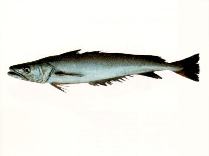
Spine dorsali (totale) : 1; Raggi dorsali molli (totale) : 48 - 57; Spine anali: 0; Raggi anali molli: 40 - 46; Vertebre: 53 - 58. Body more slender than other hakes. Pectoral fins long and slender, stripe reaching anal fin in young individuals but not in fish over 50 cm in SL. Gill rakers short and thick with blunt tips. Color is steel gray on back grading to silvery white ventrally.
Body shape (shape guide): elongated; Cross section: oval.
Found at depths between 415 and 1000 m in New Zealand waters, and 62 to 800 m in South American waters. The Patagonian population feeds on southern blue whiting, whiptail, nototheniids and squids. The New Zealand population feeds mainly on fishes (especially gadoids), squids, euphausiids and benthic organisms. Adults probably migrate southward during the southern summer for feeding and return to the north in winter for spawning (Ref. 1371). Spawning takes place from August to September on the western coast of South Island, from September to November in the northern part of the Campbell Plateau, and between November and January on Chatham Rise (Ref. 58452). Utilized as food fish and fishmeal.
Life cycle and mating behavior
Maturità | Riproduzione | Deposizione | Uova | Fecundity | Larve
Cohen, D.M., T. Inada, T. Iwamoto and N. Scialabba, 1990. FAO species catalogue. Vol. 10. Gadiform fishes of the world (Order Gadiformes). An annotated and illustrated catalogue of cods, hakes, grenadiers and other gadiform fishes known to date. FAO Fish. Synop. 125(10). Rome: FAO. 442 p. (Ref. 1371)
IUCN Red List Status (Ref. 130435: Version 2025-1)
Threat to humans
Harmless
Human uses
Pesca: elevato interesse commerciale
Strumenti
Special reports
Download XML
Fonti Internet
Estimates based on models
Preferred temperature (Fonte Biblio.
123201): 6.2 - 13.3, mean 8.6 °C (based on 112 cells).
Phylogenetic diversity index (Fonte Biblio.
82804): PD
50 = 0.5000 [Uniqueness, from 0.5 = low to 2.0 = high].
Bayesian length-weight: a=0.00389 (0.00325 - 0.00465), b=3.10 (3.05 - 3.15), in cm total length, based on LWR estimates for this species (Ref.
93245).
Trophic level (Fonte Biblio.
69278): 4.3 ±0.74 se; based on food items.
Generation time: 5.7 (4.2 - 10.7) years. Estimated as median ln(3)/K based on 15
growth studies.
Resilienza (Fonte Biblio.
120179): Basso, tempo minimo di raddoppiamento della popolazione 4.5 - 14 anni (K=0.07-0.19; tm=6-10; tmax=30).
Prior r = 0.24, 95% CL = 0.16 - 0.35, Based on 4 full stock assessments.
Fishing Vulnerability (Ref.
59153): High vulnerability (56 of 100).
🛈
Climate Vulnerability (Ref.
125649): High vulnerability (61 of 100).
🛈
Nutrients (Ref.
124155): Calcium = 14.6 [5.9, 47.3] mg/100g; Iron = 0.536 [0.198, 1.332] mg/100g; Protein = 17.9 [16.7, 19.0] %; Omega3 = 0.148 [0.083, 0.263] g/100g; Selenium = 84.2 [34.5, 207.6] μg/100g; VitaminA = 11.5 [3.1, 40.8] μg/100g; Zinc = 0.314 [0.198, 0.493] mg/100g (wet weight); based on
nutrient studies.