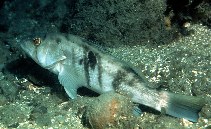
Teleostei (teleosts) >
Perciformes/Serranoidei (Groupers) >
Serranidae (Sea basses: groupers and fairy basslets)
Etymology: Paralabrax: Greek, para = the side of + Greek, labrax, -akos = a fish, Dicentrarchus labrax (Ref. 45335).
More on author: Girard.
Environment: milieu / climate zone / depth range / distribution range
Ecology
Marine; reef-associated; depth range 1 - 183 m (Ref. 2850), usually ? - 30 m (Ref. 9324). Subtropical; 37°N - 16°N, 123°W - 99°W
Eastern Pacific: ranges from Santa Cruz in central California, USA to Magdalena Bay, Baja California. Also appears in front of Acapulco, Mexico (Ref. 9342).
Size / Weight / Age
Maturity: Lm ? range ? - ? cm
Max length : 67.0 cm TL male/unsexed; (Ref. 40637); max. published weight: 6.0 kg (Ref. 40637); max. reported age: 31 years (Ref. 56049)
Usually found on sand bottom among or near rocks from shallow areas to about 183 m depth, but usually at less than 30 m. Juvenile feed on benthic invertebrates (crabs, bivalves and mysids) and rarely fish; adults prey on fishes (especially Porichthys notatus) and also on crustaceans (Ref. 9342). Pelagic spawners (Ref. 56049). Important game fish (Ref. 9342).
Pelagic spawner (Ref. 56049).
Eschmeyer, W.N., E.S. Herald and H. Hammann, 1983. A field guide to Pacific coast fishes of North America. Boston (MA, USA): Houghton Mifflin Company. xii+336 p. (Ref. 2850)
IUCN Red List Status (Ref. 130435: Version 2025-2)
Threat to humans
Harmless
Human uses
Fisheries: subsistence fisheries; gamefish: yes
Tools
Special reports
Download XML
Internet sources