



Sander lucioperca (Linnaeus, 1758)
Pike-perch
Carica il tuo foto e Video
Immagini | Video | Suoni | Francobolli, monete, materiale vario. | Google image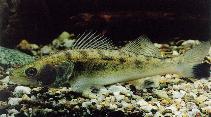 Sander lucioperca
Immagine di Zienert, S.
Immagini | Video | Suoni | Francobolli, monete, materiale vario. | Google image
Immagine di Zienert, S.
Classificazione / Nomi Nomi Comuni | Sinonimi | Catalog of Fishes(Genere, Specie) | ITIS | CoL | WoRMS | Cloffa
Ambiente: milieu / zona climatica / distribuzione batimetrica / gamma di distribuzione Ecologia
; acqua dolce; salmastro pelagico; potamodromo (Ref. 126106); distribuzione batimetrica 2 - 30 m (Ref. 30578), usually 2 - 3 m (Ref. 27368). Temperate; 6°C - 22°C (Ref. 2059); 67°N - 36°N, 1°W - 75°E
Distribuzione Territories | Aree FAO | Ecosistemi | Presenze | Mappa dei ritrovamenti | Introduzioni | Faunafri
Europe and Asia: Caspian, Baltic, Black and Aral Sea basins; Elbe (North Sea basin) and Maritza (Aegean basin) drainages. North to about 65° N in Finland. Introduced widely (Ref. 59043). Several countries report adverse ecological impact after introduction (Ref. 1739).
Lunghezza alla prima maturità / Dimensione / Peso / Età
Maturità: Lm 37.2, range 28 - 46 cm
Max length : 100.0 cm SL maschio/sesso non determinato; (Ref. 59043); common length : 50.0 cm TL maschio/sesso non determinato; (Ref. 556); peso massimo pubblicato: 20.0 kg (Ref. 40476); Età massima riportata: 17 anni (Ref. 59043)
Max length : 100.0 cm SL maschio/sesso non determinato; (Ref. 59043); common length : 50.0 cm TL maschio/sesso non determinato; (Ref. 556); peso massimo pubblicato: 20.0 kg (Ref. 40476); Età massima riportata: 17 anni (Ref. 59043)
Breve descrizione Chiavi di identificazione | Morfologia | Morfometria
Spine dorsali (totale) : 13 - 20; Raggi dorsali molli (totale) : 18 - 24; Spine anali: 2 - 3; Raggi anali molli: 10 - 14; Vertebre: 45 - 47. Distinguished from congeners in Europe by the following combination of characters: 1-2 enlarged canine teeth in anterior part of each jaw; second dorsal fin with 18-22½ branched rays; and 80-97 scales on lateral line (Ref. 59043).
Body shape (shape guide): fusiform / normal.
Body shape (shape guide): fusiform / normal.
Adults inhabit large, turbid rivers and eutrophic lakes, brackish coastal lakes and estuaries. They feed mainly on gregarious, pelagic fishes. They attain first sexual maturity at 3-10 years of age, usually at 4. Undertake short spawning migrations. Individuals foraging in brackish water move to freshwater habitats. Migrations up to 250 km have been recorded. Homing is well developed, even nearby populations may be relatively isolated. Spawn in pairs at dawn or night. Spawning occurs in April-May, exceptional from late February until July, depending on latitude and altitude when temperatures reach 10-14° C on spawning grounds (Ref. 59043). Popularly fished by sport fishers. Its flesh is succulent (Ref. 30578). Utilized fresh or frozen and eaten steamed, broiled and microwaved (Ref. 9988). An individual weighing 19 kg was reportedly caught in 1959 in Starnberger, Bavaria, Germany (Peter Admicka, pers. Comm. E-mail: peter.adamicka@oeaw.ac.at).
Ciclo vitale e comportamento di accoppiamento Maturità | Riproduzione | Deposizione | Uova | Fecondità | Larve
The spawning places are over gravel in moving water (Ref. 205). "Males are territorial and excavate shallow depressions about 50 cm in diameter and 5-10 cm deep in sand or gravel, or among exposed plant roots on which eggs are deposited, usually in turbid water and at 1-3 m depth. Spawn in pairs, at dawn or night. The female remains over the nest while the male circles rapidly around, at about 1 meter from the nest. Then male takes a vertical orientation and both swim around swiftly, and eggs and sperm are released, The female leaves the nest after all eggs are released. The male defends the nest and fans the eggs with his pectorals. Females spawn once a year, laying all the eggs at one time (Ref. 88075). Feeding larvae are positively phototactic and feed on pelagic organisms after they leave the nest for open water" (Ref. 59043).
Riferimento principale
Caricare le referenze | Bibliografia | Coordinatore | Collaboratori
Kottelat, M. and J. Freyhof, 2007. Handbook of European freshwater fishes. Publications Kottelat, Cornol and Freyhof, Berlin. 646 pp. (Ref. 59043)
Stato della Lista Rossa IUCN (Ref. 130435: Version 2025-2 (Global))
Least Concern (LC) ; Date assessed: 27 May 2022
CITES
Not Evaluated
Minaccia per l'uomo
Potential pest (Ref. 57271)
Usi umani
Pesca: commerciale; Acquacoltura: commerciale; Pesce da pesca sportiva: si; Acquario: Acquari pubblici
FAO - Sistemi di acquacoltura: produzione, profilo della specie; pesca: sbarchi, profilo della specie; Publication: search | FishSource | Sea Around Us
Informazioni ulteriori
Ecologia trofica
Articoli alimentari (prede)
Alimentazione
Consumo di cibo
Razioni alimentari
Predatori
Articoli alimentari (prede)
Alimentazione
Consumo di cibo
Razioni alimentari
Predatori
Dinamica della popolazione
Parametri di crescita
Età massima / dimensioni massime
Rapporto lunghezza-peso.
Lunghezza-lunghezza rel.
Lunghezza-frequenze
Conversione di massa
Reclutamento
Abbondanza
Parametri di crescita
Età massima / dimensioni massime
Rapporto lunghezza-peso.
Lunghezza-lunghezza rel.
Lunghezza-frequenze
Conversione di massa
Reclutamento
Abbondanza
Ciclo di vita
Riproduzione
Maturità
Maturità/Gli occhielli sono relativi.
Fecondità
Deposizione
Aggregazioni riproduttive
Uova
Sviluppo delle uova
Larve
Dinamica popolazioni larvali
Riproduzione
Maturità
Maturità/Gli occhielli sono relativi.
Fecondità
Deposizione
Aggregazioni riproduttive
Uova
Sviluppo delle uova
Larve
Dinamica popolazioni larvali
Fisiologia
Composizione corporea
Nutrienti
Consumo di ossigeno
Tipo di nuoto
Velocità di nuoto
Pigmenti visivi
Suono del pesce
Malattie e parassiti
Tossicità (LC50)
Composizione corporea
Nutrienti
Consumo di ossigeno
Tipo di nuoto
Velocità di nuoto
Pigmenti visivi
Suono del pesce
Malattie e parassiti
Tossicità (LC50)
Legato all'uomo
Sistemi di acquacoltura
Profili di acquacoltura
Varietà
Casi di Ciguatera
Francobolli, monete, materiale vario.
Sistemi di acquacoltura
Profili di acquacoltura
Varietà
Casi di Ciguatera
Francobolli, monete, materiale vario.
Strumenti
Quiz organico | Libro elettronico | Giuda pratica | Chiavi di identificazione | Generatore frequenze di lunghezza | Strumento Parametri Biologici | Mappa dei ritrovamenti |
Cattura-MSY |
Rapporti speciali
Controllo della manutenzione dell'acquario | Verificare la presenza di schede informative sulle specie | Verifica delle schede informative sull'acquacoltura
Scarica XML
Fonti Internet
AFORO (otoliths) | Alien/Invasive Species database | Aquatic Commons | BHL | Cloffa | Websites from users | Check FishWatcher | CISTI | Catalog of Fishes: Genere, Specie | DiscoverLife | DORIS | ECOTOX | FAO - Sistemi di acquacoltura: produzione, profilo della specie; pesca: sbarchi, profilo della specie; Publication: search | Faunafri | Fishipedia | Fishtrace | GloBI | Google Books | Google Scholar | Google | IGFA World Record | Database Nazionali | OneZoom | Open Tree of Life | Otolith Atlas of Taiwan Fishes | Acquari pubblici | PubMed | Reef Life Survey | Socotra Atlas | TreeBase | Tree of Life | Wikipedia: Go, ricerca | World Records Freshwater Fishing | Record zoologico
Stime basate su modelli
Indice di diversità filogenetica (Fonte Biblio. 82804): PD50 = 0.5312 [Uniqueness, from 0.5 = low to 2.0 = high].
Bayesian length-weight: a=0.00589 (0.00494 - 0.00702), b=3.12 (3.07 - 3.17), in cm total length, based on LWR estimates for this species (Ref. 93245).
Livello trofico (Fonte Biblio. 69278): 4.0 ±0.78 se; based on food items.
Generation time: 8.2 (5.8 - 12.2) years. Estimated as median ln(3)/K based on 19 growth studies.
Resilienza (Fonte Biblio. 120179): Basso, tempo minimo di raddoppiamento della popolazione 4.5 - 14 anni (K=0.10-0.24; tmax=16; Fecundity=10,000).
Nutrienti (Ref. 124155): Calcium = 50.9 [29.3, 80.5] mg/100g; Iron = 0.262 [0.132, 0.524] mg/100g; Protein = 18.8 [17.9, 19.6] %; Omega3 = 0.496 [0.193, 0.969] g/100g; Selenium = 2.25 [0.74, 7.60] μg/100g; VitaminA = 17 [6, 52] μg/100g; Zinc = 0.729 [0.551, 0.986] mg/100g (wet weight); based on nutrient studies.