



Sander lucioperca (Linnaeus, 1758)
Pike-perch
Adicionar o seu Fotografias e vídeos
Fotografias | vídeos | Sons | Selos, moedas, diversos. | Imagem do Google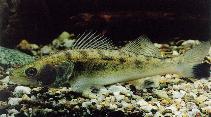 Sander lucioperca
Fotografia de Zienert, S.
Fotografias | vídeos | Sons | Selos, moedas, diversos. | Imagem do Google
Fotografia de Zienert, S.
Classificação / Nomes Nomes comuns | Sinónimos | Catalog of Fishes(Género, Espécies) | ITIS | CoL | WoRMS | Cloffa
Ambiente: milieu / zona climática / intervalo de profundidade / gama de distribuição Ecologia
; Água doce; estuarina pelágico(a,os,as); potamódromo (Ref. 126106); intervalo de profundidade 2 - 30 m (Ref. 30578), usually 2 - 3 m (Ref. 27368). Temperate; 6°C - 22°C (Ref. 2059); 67°N - 36°N, 1°W - 75°E
Distribuição Territórios | Áreas FAO | Ecossistemas | Ocorrências | Mapa dos pontos | Introduções | Faunafri
Europe and Asia: Caspian, Baltic, Black and Aral Sea basins; Elbe (North Sea basin) and Maritza (Aegean basin) drainages. North to about 65° N in Finland. Introduced widely (Ref. 59043). Several countries report adverse ecological impact after introduction (Ref. 1739).
Comprimento na primeira maturidade / Tamanho / Peso / Idade
Maturidade: Lm 37.2, range 28 - 46 cm
Max length : 100.0 cm SL macho/indeterminado; (Ref. 59043); common length : 50.0 cm TL macho/indeterminado; (Ref. 556); peso máx. Publicado: 20.0 kg (Ref. 40476); Idade máx. registada: 17 anos (Ref. 59043)
Max length : 100.0 cm SL macho/indeterminado; (Ref. 59043); common length : 50.0 cm TL macho/indeterminado; (Ref. 556); peso máx. Publicado: 20.0 kg (Ref. 40476); Idade máx. registada: 17 anos (Ref. 59043)
Descrição breve Chaves de identificação | Morfologia | Morfometria
Espinhos dorsais (total) : 13 - 20; Raios dorsais moles (total) : 18 - 24; Espinhos anais: 2 - 3; Raios anais moles: 10 - 14; Vértebras: 45 - 47. Distinguished from congeners in Europe by the following combination of characters: 1-2 enlarged canine teeth in anterior part of each jaw; second dorsal fin with 18-22½ branched rays; and 80-97 scales on lateral line (Ref. 59043).
Body shape (shape guide): fusiform / normal.
Body shape (shape guide): fusiform / normal.
Adults inhabit large, turbid rivers and eutrophic lakes, brackish coastal lakes and estuaries. They feed mainly on gregarious, pelagic fishes. They attain first sexual maturity at 3-10 years of age, usually at 4. Undertake short spawning migrations. Individuals foraging in brackish water move to freshwater habitats. Migrations up to 250 km have been recorded. Homing is well developed, even nearby populations may be relatively isolated. Spawn in pairs at dawn or night. Spawning occurs in April-May, exceptional from late February until July, depending on latitude and altitude when temperatures reach 10-14° C on spawning grounds (Ref. 59043). Popularly fished by sport fishers. Its flesh is succulent (Ref. 30578). Utilized fresh or frozen and eaten steamed, broiled and microwaved (Ref. 9988). An individual weighing 19 kg was reportedly caught in 1959 in Starnberger, Bavaria, Germany (Peter Admicka, pers. Comm. E-mail: peter.adamicka@oeaw.ac.at).
Ciclo de vida e comportamento de acasalamento Maturidade | Reprodução | Desova | Ovos | Fecundidade | Larvas
The spawning places are over gravel in moving water (Ref. 205). "Males are territorial and excavate shallow depressions about 50 cm in diameter and 5-10 cm deep in sand or gravel, or among exposed plant roots on which eggs are deposited, usually in turbid water and at 1-3 m depth. Spawn in pairs, at dawn or night. The female remains over the nest while the male circles rapidly around, at about 1 meter from the nest. Then male takes a vertical orientation and both swim around swiftly, and eggs and sperm are released, The female leaves the nest after all eggs are released. The male defends the nest and fans the eggs with his pectorals. Females spawn once a year, laying all the eggs at one time (Ref. 88075). Feeding larvae are positively phototactic and feed on pelagic organisms after they leave the nest for open water" (Ref. 59043).
Referência principal
Carregar as suas referências | Referências | Coordenador | Colaboradores
Kottelat, M. and J. Freyhof, 2007. Handbook of European freshwater fishes. Publications Kottelat, Cornol and Freyhof, Berlin. 646 pp. (Ref. 59043)
Categoria na Lista Vermelha da IUCN (Ref. 130435: Version 2025-2 (Global))
Preocupação menor (LC) ; Date assessed: 27 May 2022
CITES
Not Evaluated
Ameaça para o homem
Potential pest (Ref. 57271)
Utilização humana
Pescarias: espécies comerciais; Aquacultura: espécies comerciais; peixe desportivo: sim; Aquário: Aquários públicos
FAO - Sistemas de aquacultura: produção, perfil da espécie; pescarias: desembarques, perfil da espécie; Publication: search | FishSource | Sea Around Us
Mais informação
Ecologia Trófica
Produtos alimentares (presas)
Composição da dieta
Consumo alimentar
Rações alimentares
Predadores
Produtos alimentares (presas)
Composição da dieta
Consumo alimentar
Rações alimentares
Predadores
Dinâmica das populações
Parâmetros de crescimento
Idades / tamanhos máximos
Comprimento-peso rel.
Comprimento-comprimento rel.
Frequência de comprimento
Conversão de massa
Recrutamento
Abundância
Parâmetros de crescimento
Idades / tamanhos máximos
Comprimento-peso rel.
Comprimento-comprimento rel.
Frequência de comprimento
Conversão de massa
Recrutamento
Abundância
Ciclo de vida
Reprodução
Maturidade
Maturidade/Rel. das guelras
Fecundidade
Desova
Agregações de desova
Ovos
Desenvolvimento dos ovos
Larvas
Dinâmica larvar
Reprodução
Maturidade
Maturidade/Rel. das guelras
Fecundidade
Desova
Agregações de desova
Ovos
Desenvolvimento dos ovos
Larvas
Dinâmica larvar
Fisiologia
Composição corporal
Nutrientes
Consumo de oxigénio
Tipo de natação
Velocidade de natação
Pigmentos visuais
Som de peixe
Doenças e Parasitas
Toxicidade (LC50s)
Composição corporal
Nutrientes
Consumo de oxigénio
Tipo de natação
Velocidade de natação
Pigmentos visuais
Som de peixe
Doenças e Parasitas
Toxicidade (LC50s)
Relacionado com o ser humano
Sistemas de aquacultura
Perfis para aquacultura
Estirpes
Casos de Ciguatera
Selos, moedas, diversos.
Sistemas de aquacultura
Perfis para aquacultura
Estirpes
Casos de Ciguatera
Selos, moedas, diversos.
Ferramentas
Questionário orgânico | E-book | Guia de campo | Chaves de identificação | Ferramenta auxiliar de frequências de comprimento | Ferramenta sobre a história de vida | Mapa dos pontos |
Captura-MSY |
Relatórios especiais
Descarregue XML
Fontes da internet
AFORO (otoliths) | Alien/Invasive Species database | Aquatic Commons | BHL | Cloffa | Websites from users | Consultar FishWatcher | CISTI | Catalog of Fishes: Género, Espécies | DiscoverLife | DORIS | ECOTOX | FAO - Sistemas de aquacultura: produção, perfil da espécie; pescarias: desembarques, perfil da espécie; Publication: search | Faunafri | Fishipedia | Fishtrace | GloBI | Google Books | Google Scholar | Google | IGFA World Record | Bases de dados nacionais | OneZoom | Open Tree of Life | Otolith Atlas of Taiwan Fishes | Aquários públicos | PubMed | Reef Life Survey | Socotra Atlas | TreeBase | Árvore da vida | Wikipedia: ir para, procurar | World Records Freshwater Fishing | Registo zoológico
Estimativas baseadas em modelos
Índice de diversidade filogenética (Ref. 82804): PD50 = 0.5312 [Uniqueness, from 0.5 = low to 2.0 = high].
Bayesian length-weight: a=0.00589 (0.00494 - 0.00702), b=3.12 (3.07 - 3.17), in cm total length, based on LWR estimates for this species (Ref. 93245).
Nível Trófico (Ref. 69278): 4.0 ±0.78 se; based on food items.
Generation time: 8.2 (5.8 - 12.2) years. Estimated as median ln(3)/K based on 19 growth studies.
Resiliência (Ref. 120179): Baixo, tempo mínimo de duplicação da população 4,5 - 14 anos (K=0.10-0.24; tmax=16; Fecundity=10,000).
Nutrientes (Ref. 124155): Calcium = 50.9 [29.3, 80.5] mg/100g; Iron = 0.262 [0.132, 0.524] mg/100g; Protein = 18.8 [17.9, 19.6] %; Omega3 = 0.496 [0.193, 0.969] g/100g; Selenium = 2.25 [0.74, 7.60] μg/100g; VitaminA = 17 [6, 52] μg/100g; Zinc = 0.729 [0.551, 0.986] mg/100g (wet weight); based on nutrient studies.