>
Ovalentaria/misc (Various families in series Ovalentaria) >
Embiotocidae (Surfperches)
Etymology: Phanerodon: Greek, phaner, -eros = visible + Greek, odous = teeth (Ref. 45335).
More on author: Girard.
Environment: milieu / Klimaatzone / Diepte / distribution range
Ecologie
marien demersaal; diepte ? - 46 m (Ref. 2850). Subtropical; 61°N - 28°N, 147°W - 113°W
Eastern Pacific: Wrangell, southeastern Alaska to Guadalupe Island, off north-central Baja California, Mexico.
Grootte / Gewicht / Leeftijd
Maturiteit: Lm ? range ? - ? cm
Max length : 44.2 cm SL mannelijk / geslacht onbekend; (Ref. 27436)
Korte beschrijving
Determinatiesleutels | Morfologie | Morfometrie
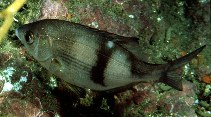
Dorsale stekels (totaal) : 9 - 11; Dorsale zachte stralen (totaal) : 21 - 25; Anale stekels: 3; Anale zachte stralen: 27 - 30; Wervels: 33 - 38. Above, dark gray or brown pigment with a silvery luster which dominates the color on sides and belly; darker blotches on the back and sides, dark vertical bars on juveniles; fins dusky (Ref. 6885).
Body shape (shape guide): short and / or deep.
Adults occur in rocky shores, often around kelp, pilings and underwater structures (Ref. 2850). Feed on hard-shelled mollusks, crabs and barnacles (Ref. 2850). Viviparous, female carries the developing young (Ref. 205).
Levenscyclus en paargedrag
Maturiteit | Voortplanting | Paaien | Eieren | Fecunditeit | Larven
Viviparous, female carries the developing young (Ref. 205).
Eschmeyer, W.N., E.S. Herald and H. Hammann, 1983. A field guide to Pacific coast fishes of North America. Boston (MA, USA): Houghton Mifflin Company. xii+336 p. (Ref. 2850)
Status op de Rode Lijst van het IUCN (Ref. 130435: Version 2025-1)
Gevaar voor de mens
Harmless
Gebruik door de mens
Visserij: commercieel; sportvis: ja; Aquarium: Publieke aquaria
Tools
Speciale rapporten
Download XML
Internetbronnen
Estimates based on models
Preferred temperature (Ref.
123201): 8.6 - 15.3, mean 10.3 °C (based on 62 cells).
Fylogenetische diversiteitsindex (Ref.
82804): PD
50 = 0.6250 [Uniqueness, from 0.5 = low to 2.0 = high].
Bayesian length-weight: a=0.01905 (0.00827 - 0.04391), b=2.97 (2.77 - 3.17), in cm total length, based on LWR estimates for this (Sub)family-body shape (Ref.
93245).
Trofisch niveau (Ref.
69278): 3.4 ±0.53 se; based on food items.
Weerstandsvermogen (Ref.
120179): Gemiddeld, minimale populatieverdubbelingstijd 1,4-4,4 jaar (tm=2.5; tmax=10).
Fishing Vulnerability (Ref.
59153): Moderate vulnerability (42 of 100).
🛈
Nutrients (Ref.
124155): Calcium = 79.1 [44.3, 138.1] mg/100g; Iron = 1.02 [0.59, 1.72] mg/100g; Protein = 18.7 [17.7, 19.6] %; Omega3 = 0.254 [0.160, 0.409] g/100g; Selenium = 25 [13, 49] μg/100g; VitaminA = 8.16 [2.50, 25.90] μg/100g; Zinc = 0.674 [0.481, 0.977] mg/100g (wet weight);