>
Perciformes/Zoarcoidei (Eelpouts and pricklebacks) >
Lumpenidae (Eel pricklebacks)
Etymology: Poroclinus: Greek, poros = porous + Greek, klinein, kline = sloping and bed, due to the four apophyses of sphenoid bone (Ref. 45335); rothrocki: Named for Dr. J.T. Rothrock, botanist at the Universitiy of Pennsylvania (Ref. 6885).
Eponymy: Joseph Trimble Rothrock (1839–1922) was an American physician, botanist and an early environmentalist. He served as the first President of the Pennsylvania Forestry Association, which supported the creation of state parks and state forests. (Ref. 128868), visit book page.
More on author: Bean.
Environment: milieu / climate zone / Tiefenbereich / distribution range
Ökologie
seewasser demersal; tiefenbereich 46 - 128 m (Ref. 2850). Temperate
Eastern Pacific: Bering Sea to San Diego, California, USA.
Size / Gewicht / Alter
Geschlechtsreife: Lm ? range ? - ? cm
Max length : 25.0 cm TL Männchen/unbestimmt; (Ref. 2850)
Kurzbeschreibung
Bestimmungsschlüssel | Morphologie | Morphometrie
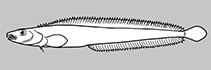
Rückenflossenstacheln (insgesamt) : 57 - 67; Rückenflossenweichstrahlen (insgesamt) : 0; Afterflossenstacheln: 3; Afterflossenweichstrahlen: 40 - 44. Caudal long, narrow, bluntly pointed; pectorals broad and rounded (Ref. 6885). Light brown on dorsal surfaces, lighter ventrally; about 10 to 12 white vertical bars edged with brown in a series on upper part of body, spreading or dividing to become confluent with pale ventral coloring; small brown smudges at bases of membranes between spines of posterior part of dorsal fin (Ref. 6885).
Inhabits sandy to rocky bottoms at depths of 46 to 128 meters (Ref. 51666).
Life cycle and mating behavior
Geschlechtsreife | Fortpflanzung | Ablaichen | Eier | Fecundity | Larven
Eschmeyer, W.N., E.S. Herald and H. Hammann, 1983. A field guide to Pacific coast fishes of North America. Boston (MA, USA): Houghton Mifflin Company. xii+336 p. (Ref. 2850)
IUCN Rote Liste Status (Ref. 130435: Version 2025-1)
Bedrohung für Menschen
Harmless
Nutzung durch Menschen
Tools
Zusatzinformationen
Download XML
Internet Quellen
Estimates based on models
Preferred temperature (Ref.
123201): 1.3 - 8.8, mean 4.9 °C (based on 133 cells).
Phylogenetic diversity index (Ref.
82804): PD
50 = 1.0005 [Uniqueness, from 0.5 = low to 2.0 = high].
Bayesian length-weight: a=0.00363 (0.00151 - 0.00871), b=2.95 (2.74 - 3.16), in cm total length, based on LWR estimates for this (Sub)family-body shape (Ref.
93245).
Trophic level (Ref.
69278): 3.2 ±0.4 se; based on size and trophs of closest relatives
Widerstandsfähigkeit (Ref.
120179): mittel, Verdopplung der Population dauert 1,4 - 4,4 Jahre. (Preliminary K or Fecundity.).
Fishing Vulnerability (Ref.
59153): Low vulnerability (15 of 100).
🛈