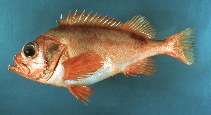
Sebastes fasciatus, Acadian redfish

You can sponsor this page

Sebastes fasciatus Storer, 1854

Acadian redfish
Adicionar sua observação em Fish Watcher
Native range | All suitable habitat | Point map | Year 2050
This map was computer-generated and has not yet been reviewed.
Sebastes fasciatus   AquaMaps   Data sources: GBIF OBIS
Carregue seu(sua) Fotos e vídeos
Fotos | Imagem do Google
Image of Sebastes fasciatus (Acadian redfish)
Sebastes fasciatus
Foto de Flescher, D.

Classificação / Nomes Nomes comuns | Sinônimos | Catalog of Fishes(Gênero, Espécies) | ITIS | CoL | WoRMS | Cloffa

> Perciformes/Scorpaenoidei (Scorpionfishes) > Sebastidae (Rockfishes, rockcods and thornyheads) > Sebastinae
Etymology: Sebastes: Greek, sebastes = august, venerable (Ref. 45335).

Environment: milieu / Zona climática / intervalo de profundidade / distribution range Ecologia

marinhas demersal; intervalo de profundidade 70 - 592 m (Ref. 5951), usually 128 - 366 m (Ref. 5951). Temperate; 74°N - 35°N, 75°W - 13°W

Distribuição Países | Áreas da FAO | Ecossistemas | Ocorrências | Mapa de pontos | Introduções | Faunafri

Northwest Atlantic: Gulf of St. Lawrence to shelf waters of Nova Scotia in Canada. Northeast Atlantic: off Iceland and western Greenland (Ref. 4570).

Comprimento de primeira maturação / Tamanho / Peso / Idade

Maturidade: Lm 22.3  range ? - ? cm
Max length : 47.0 cm TL macho/indeterminado; (Ref. 49746)

Biologia     Glossário (p.ex. epibenthic)

Inhabits shallow water; rocky or clay-silt bottom (Ref. 5951). Bears live young. Gregarious during all life. Feeds on euphausiids, decapods, mysids, small mollusks and fishes. Ovoviviparous (Ref. 4570). A long-lived species with estimated life span of 30-50 years, slow growing and has low fecundity. Late juveniles (11-20 cm total length) were primarily associated with boulder reefs that have deep interstices amongst the boulders; as well as in exposed boulders that do not have crevices along their lower margins, but are surrounded by dense patches of cerianthid anemones, Cerianthus borealis. The use of both boulder and cerianthid habitats are either on an encounter basis, regardless of habitat saturation or predation pressure, or because boulder reefs serve as recruitment habitats, and cerianthid habitats serve as a conduit for redfish moving away from saturated boulder reef sites (Ref. 58487).

Ciclo de vida ou comportamento de acasalamento Maturidade | Reprodução | Desova | Ovos | Fecundidade | Larvas

Ovoviviparous (Ref. 4570).

Referência principal Carregar suas referências | Referências | Coordenador | Colaboradores

Robins, C.R. and G.C. Ray, 1986. A field guide to Atlantic coast fishes of North America. Houghton Mifflin Company, Boston, U.S.A. 354 p. (Ref. 7251)

Status na Lista Vermelha da UICN (Ref. 130435: Version 2025-1)

  Em perigo (EN) (A1bd); Date assessed: 01 August 1996

CITES

Not Evaluated

CMS (Ref. 116361)

Not Evaluated

Ameaça para os humanos

  Harmless


Uso pelos humanos

FAO - pescarias: perfil da espécie; Publication: search | FishSource | Sea Around Us

Mais informação

Ecologia Trófica
Food items (preys)
Composição da dieta
Consumo alimentar
Food rations
Predadores
Ecologia
Ecologia
Home ranges
Population dynamics
Parâmetros de crescimento
Max. ages / sizes
Length-weight rel.
Length-length rel.
Frequências de comprimento
Conversão de massa
Recrutamento
Abundância
Life cycle
Reprodução
Maturidade
Maturity/Gills rel.
Fecundidade
Desova
Spawning aggregations
Ovos
Desenvolvimento dos ovos
Larvas
Dinâmica larval
Distribuição
Países
Áreas da FAO
Ecossistemas
Ocorrências
Introduções
BRUVS - Videos
Anatomy
Área branquial
Brain
Otolith
Physiology
Body composition
Nutrients
Consumo de oxigênio
Tipo de natação
Velocidade de natação
Visual pigments
Fish sound
Diseases & Parasites
Toxicity (LC50s)
Genética
genoma
Genética
Heterozygosity
Hereditariedade
Human related
Aquaculture systems
Perfis para aquacultura
Estirpes
Ciguatera cases
Stamps, coins, misc.
Outreach
Colaboradores
Taxonomy
Nomes comuns
Sinônimos
Morfologia
Morfometria
Fotos
Referências
Referências

Ferramentas

Relatórios especiais

Baixar XML

Fontes da internet

Estimates based on models

Preferred temperature (Ref. 123201): 0.8 - 7.8, mean 5.2 °C (based on 147 cells).
Índice de diversidade filogenética (Ref. 82804):  PD50 = 0.5000   [Uniqueness, from 0.5 = low to 2.0 = high].
Bayesian length-weight: a=0.01023 (0.00682 - 0.01535), b=3.13 (3.01 - 3.25), in cm total length, based on LWR estimates for this species & Genus-body shape (Ref. 93245).
Nível Trófico (Ref. 69278):  3.2   ±0.2 se; based on diet studies.
Resiliência (Ref. 120179):  Baixo, tempo mínimo de duplicação da população 4,5 - 14 anos (tm=5.5).
Prior r = 0.07, 95% CL = 0.05 - 0.11, Based on 1 full stock assessment.
Fishing Vulnerability (Ref. 59153):  Moderate to high vulnerability (49 of 100). 🛈
Nutrients (Ref. 124155):  Calcium = 31.1 [11.9, 105.5] mg/100g; Iron = 0.275 [0.114, 0.699] mg/100g; Protein = 17.6 [16.4, 18.8] %; Omega3 = 1.34 [0.56, 3.30] g/100g; Selenium = 39.4 [14.5, 112.6] μg/100g; VitaminA = 28.4 [8.6, 92.1] μg/100g; Zinc = 0.469 [0.244, 0.840] mg/100g (wet weight);