Environment: milieu / climate zone / depth range / distribution range
Ecology
Marine; demersal; depth range 18 - 800 m (Ref. 6793). Temperate
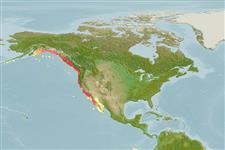
Eastern Pacific: Chirikof Island in the western Gulf of Alaska to Point Loma and Cortez Bank, southern California, USA.
Size / Weight / Age
Maturity: Lm ? range ? - ? cm
Max length : 27.0 cm TL male/unsexed; (Ref. 2850)
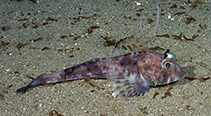
Dorsal spines (total): 9 - 11; Dorsal soft rays (total): 15 - 18; Anal spines: 0; Anal soft rays: 13 - 15. Caudal fin fanned out, bluntly rounded; pelvic fins small, extending about one-third distance to anal origin (Ref. 6885). Color olive green to light brown on dorsal surface, creamy yellow to light brown on ventral surface, 4 dark saddles across back, bars of dark blotches on all fins except pelvic and anal fins; sometimes dusky along margin of anal fin; males sometimes variously blotched with orange to red; silvery areas anterior to and behind base of pectorals (Ref. 6885).
Body shape (shape guide): elongated.
Commonly found on sand and mud bottoms (Ref. 2850). Feeds on crustaceans, including shrimps and isopods (Ref. 6885).
Life cycle and mating behavior
Maturity | Reproduction | Spawning | Eggs | Fecundity | Larvae
Eschmeyer, W.N., E.S. Herald and H. Hammann, 1983. A field guide to Pacific coast fishes of North America. Boston (MA, USA): Houghton Mifflin Company. xii+336 p. (Ref. 2850)
IUCN Red List Status (Ref. 130435: Version 2025-2)
Threat to humans
Harmless
Human uses
Tools
Special reports
Download XML
Internet sources