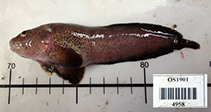
Environment: milieu / climate zone / distribuzione batimetrica / distribution range
Ecologia
marino demersale; distribuzione batimetrica 0 - 647 m (Ref. 50610), usually 100 - 200 m (Ref. 5951). Polar; 84°N - 43°N, 180°W - 180°E (Ref. 117245)
Arctic, Northwest to Northeast Atlantic, Northeast Pacific: Greenland, Canada, and southeastern Alaska (Ref. 2850).
Size / Peso / Age
Maturità: Lm ? range ? - ? cm
Max length : 52.0 cm TL maschio/sesso non determinato; (Ref. 2850)
Occurs among seaweeds or rocks (Ref. 7251). Often found in empty scallop shells (Ref. 7251). Benthic species. Feeds on crustaceans (Ref. 58426), such as amphipods and crabs (Ref. 5951).
Life cycle and mating behavior
Maturità | Riproduzione | Deposizione | Uova | Fecundity | Larve
Robins, C.R., R.M. Bailey, C.E. Bond, J.R. Brooker, E.A. Lachner, R.N. Lea and W.B. Scott, 1991. Common and scientific names of fishes from the United States and Canada. Am. Fish. Soc. Spec. Publ. (20):183 p. (Ref. 3814)
IUCN Red List Status (Ref. 130435: Version 2025-1)
Threat to humans
Harmless
Human uses
Pesca: di nessun interesse
Strumenti
Special reports
Download XML
Fonti Internet
Estimates based on models
Preferred temperature (Fonte Biblio.
123201): -1.4 - 5.9, mean -0.3 °C (based on 868 cells).
Phylogenetic diversity index (Fonte Biblio.
82804): PD
50 = 0.5000 [Uniqueness, from 0.5 = low to 2.0 = high].
Bayesian length-weight: a=0.01202 (0.00505 - 0.02860), b=3.05 (2.84 - 3.26), in cm total length, based on LWR estimates for this (Sub)family-body shape (Ref.
93245).
Trophic level (Fonte Biblio.
69278): 3.7 ±0.3 se; based on diet studies.
Resilienza (Fonte Biblio.
120179): Medio, tempo minimo di raddoppiamento della popolazione 1.4 - 4.4 anni (Fec=4,000-12,000).
Fishing Vulnerability (Ref.
59153): Moderate vulnerability (41 of 100).
🛈