分类 / Names
俗名 | 同种异名 | Catalog of Fishes(属, 种) | ITIS | CoL | WoRMS | Cloffa
Environment: milieu / climate zone / 深度上下限 / distribution range
生态学
海洋; 淡水; 半咸淡水 居于水底的; 降海洄游 (Ref. 46888); 深度上下限 0 - 5 m (Ref. 86942). 熱帶; 30°N - 35°S, 24°E - 138°W
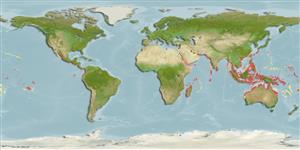
Indo-Pacific: Persian Gulf (Ref.80050) and Red Sea to Samoa, north to Japan. Collected at Natal, South Africa (Ref. 11228).
印度-太平洋: 紅海到美屬薩摩亞,北至日本。 在南非的納塔爾採集到了。 (參考文獻 11228)
大小 / 重量 / 年龄
成熟度: Lm ? range ? - ? cm
Max length : 40.0 cm SL 雄鱼/尚未辨别雌雄; (Ref. 9812); common length : 25.0 cm TL 雄鱼/尚未辨别雌雄; (Ref. 9812)
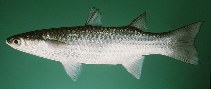
背棘 (总数) : 4 - 5; 背的软条 (总数) : 8 - 9; 臀棘: 3; 臀鳍软条: 9. Dark greenish dorsally, brownish over head, white ventrally; 3-6 indistinct, dark stripes along upper rows of scales; greyish dorsal fins; caudal fin bluish with black margin (Ref. 9812). Yellowish pectoral fin and may have a blue spot at fin origin (Ref. 9812).
Body shape (shape guide): fusiform / normal.
深色的呈绿色的背面, 褐色的在头上, 腹侧白色的; 3-6条不明显又深色的斑纹沿着上面的列鳞片; 略灰色的背鳍; 尾鳍蓝色的有黑色的边缘。 (参考文献 9812) 淡黄色的胸鳍而且可能在鳍起源有一个蓝色的斑点.(参考文献 9812)
Form schools in shallow coastal waters and enters lagoons, estuaries, and fresh water to feed (Ref. 9812). Juveniles may enter rice fields and mangroves (Ref. 9812). Feed on small algae, diatoms and benthic detrital material taken in with sand and mud; fry take zooplankton, diatoms, detrital material and inorganic sediment (Ref. 9812). Oviparous, eggs are pelagic and non-adhesive (Ref. 205). Spawning occurs at sea. Also caught with stakenets (Ref. 9812). Marketed fresh and salted.
群游于沿岸浅水区而且进入舄湖,河口与淡水到吃。 (参考文献 9812) 稚鱼可能进入稻田与红树林。 (参考文献 9812) 吃被与沙子与泥一起吃进去的小的藻类,硅藻与底栖的碎屑物质; 鱼苗吃浮游动物,硅藻,碎屑物质与无机的沉淀物。 (参考文献 9812) 卵生的.(参考文献 205) 产卵发生在海洋。 也用标桩网捕获。 (参考文献 9812) 在市场上销售生鲜地了与盐腌的。
Life cycle and mating behavior
成熟度 | 繁殖 | 产卵场 | 卵 | 孕卵数 | 仔鱼
印度-太平洋: 紅海到美屬薩摩亞,北至日本。 在南非的納塔爾採集到了。 (參考文獻 11228)
Thomson, J.M., 1984. Mugilidae. In W. Fischer and G. Bianchi (eds.) FAO species identification sheets for fishery purposes. Western Indian Ocean (Fishing Area 51). volume 3. [pag. var.]. FAO, Rome. (Ref. 2830)
世界自然保护联盟红皮书 (Ref. 130435: Version 2025-1)
人类利用
渔业: 商业性; 养殖: 商业性; 诱饵: usually
工具
特别资料
下载 XML
网络资源
Estimates based on models
Preferred temperature (参考文献
123201): 25.2 - 29.3, mean 28.4 °C (based on 3436 cells).
Phylogenetic diversity index (参考文献
82804): PD
50 = 0.5001 [Uniqueness, from 0.5 = low to 2.0 = high].
Bayesian length-weight: a=0.01259 (0.01055 - 0.01502), b=2.93 (2.90 - 2.96), in cm total length, based on LWR estimates for this species (Ref.
93245).
营养阶层 (参考文献
69278): 2.7 ±0.30 se; based on food items.
回复力 (参考文献
120179): 中等的, 族群倍增时间最少 1.4 - 4.4年 (K=0.15-0.63;).
Fishing Vulnerability (Ref.
59153): Low to moderate vulnerability (32 of 100).
🛈
Nutrients (Ref.
124155): Calcium = 173 [76, 396] mg/100g; Iron = 1.16 [0.53, 2.47] mg/100g; Protein = 18.2 [16.5, 19.9] %; Omega3 = 0.262 [0.128, 0.590] g/100g; Selenium = 31.5 [15.5, 77.1] μg/100g; VitaminA = 24 [6, 81] μg/100g; Zinc = 1.86 [1.24, 2.81] mg/100g (wet weight);