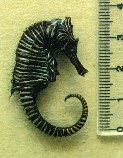
Teleostei (teleosts) >
Syngnathiformes (Pipefishes and seahorses) >
Syngnathidae (Pipefishes and seahorses) > Syngnathinae
Etymology: Hippocampus: Greek, ippos = horse + Greek,kampe = curvature (Ref. 45335).
More on author: Whitley.
Environment: milieu / climate zone / depth range / distribution range
Ecology
Marine; reef-associated; non-migratory; depth range 20 - 69 m (Ref. 52034), usually 20 - ? m (Ref. 30915). Tropical; 11°S - 27°S
Indo-West Pacific: Australia.
Length at first maturity / Size / Weight / Age
Maturity: Lm 7.0 range ? - ? cm
Max length : 8.0 cm OT male/unsexed; (Ref. 30915)
Short description
Identification keys | Morphology | Morphometrics
Found inshore on reef areas (Ref. 7300). Ovoviviparous (Ref. 205). The male carries the eggs in a brood pouch which is found under the tail (Ref. 205). Also found in sand and mud bottoms, possibly associated with gorgonians (Ref 90102).
Life cycle and mating behavior
Maturity | Reproduction | Spawning | Eggs | Fecundity | Larvae
Male carries the eggs in a brood pouch (Ref. 205).
Lourie, S.A., R.A. Pollom and S.J. Foster, 2016. A global revision of the seahorses Hippocampus Rafinesque 1810 (Actinopterygii: Syngnathiformes): taxonomy and biogeography with recommendations for further research. Zootaxa 4146(1):1-66. (Ref. 115213)
IUCN Red List Status (Ref. 130435: Version 2025-2)
Threat to humans
Harmless
Human uses
Tools
Special reports
Download XML
Internet sources