>
Perciformes/Cottoidei (Sculpins) >
Liparidae (Snailfishes)
Etymology: Paraliparis: Greek, para = the side of + Greek, liparis = fat (Ref. 45335); charcoti: Named for J.B. Charcot.
Eponymy: Jean-Baptiste Auguste Étienne Charcot (1867–1936) was a French scientist, physician, sportsman and leader of the French Antarctic Expedition (1904–1907). [...] (Ref. 128868), visit book page.
Environment: milieu / climate zone / distribuzione batimetrica / distribution range
Ecologia
marino batidemersale; distribuzione batimetrica 460 - 793 m (Ref. 40957). Deep-water
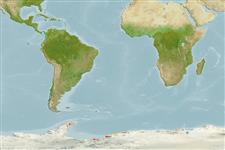
Southern Ocean: Antarctica, Halley Bay, Weddell Sea.
Size / Peso / Age
Maturità: Lm ? range ? - ? cm
Max length : 9.7 cm SL maschio/sesso non determinato; (Ref. 40957)
Short description
Chiavi di identificazione | Morfologia | Morfometria
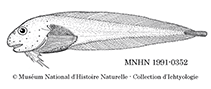
Raggi dorsali molli (totale) : 51 - 52; Raggi anali molli: 43 - 47; Vertebre: 57 - 58. Pectoral fin deeply notched, with 3 widely separated intermediate rays; five regularly spaced radials, two of them (R3 and R4) have a horseshoe nape and located at the rear edge of the basal lamina, the other three radials (R1, R2 and R5) round, R5 the largest; lack of interradial foramina (Ref. 36325).
Body shape (shape guide): elongated.
Life cycle and mating behavior
Maturità | Riproduzione | Deposizione | Uova | Fecundity | Larve
Duhamel, G., 1992. Description d'espèces nouvelles de Careproctus et Paraliparis et données nouvelles sur ces genres et le genre Edentoliparis de l'océan Austral (Cyclopteridae, Liparinae). Cybium 16(3):183-207. (Ref. 40957)
IUCN Red List Status (Ref. 130435: Version 2025-1)
Threat to humans
Harmless
Human uses
Pesca: di nessun interesse
Strumenti
Special reports
Download XML
Fonti Internet
Estimates based on models
Preferred temperature (Fonte Biblio.
123201): -1.8 - 0.6, mean -0.1 °C (based on 18 cells).
Phylogenetic diversity index (Fonte Biblio.
82804): PD
50 = 0.5000 [Uniqueness, from 0.5 = low to 2.0 = high].
Bayesian length-weight: a=0.00525 (0.00237 - 0.01161), b=3.15 (2.96 - 3.34), in cm total length, based on LWR estimates for this (Sub)family-body shape (Ref.
93245).
Trophic level (Fonte Biblio.
69278): 3.4 ±0.5 se; based on size and trophs of closest relatives
Resilienza (Fonte Biblio.
120179): Alto, tempo minimo di raddoppiamento della popolazione meno di 15 mesi (Preliminary K or Fecundity.).
Fishing Vulnerability (Ref.
59153): Low vulnerability (10 of 100).
🛈