>
Eupercaria/misc (Various families in series Eupercaria) >
Nemipteridae (Threadfin breams, Whiptail breams)
Etymology: Scolopsis: Name from the Greek masculine noun 'skolos' meaning 'thorn' and suffix '-opsis' (from Greek feminine n. 'opsis' meaning 'aspect', 'appearance') meaning ‘thorny appearance’ presumably referring to 'les dentelures de la préopercule, en ont aussi, et même d'épineuses, aux sous-orbitaires' mentioned by Cuvier (1814) in his designation of the genus. Name ending in -'opsis' are treated as feminine according to ICZN 1999: Article 30.1.2 (Ref. 130620).
More on author: Günther.
Environment: milieu / climate zone / profondeur / distribution range
Écologie
marin récifal; profondeur 5 - 50 m (Ref. 9785), usually 15 - 50 m (Ref. 9710). Tropical; 27°N - 13°S, 65°E - 167°E (Ref. 3810)
Indo-West Pacific: Maldives and Sri Lanka to the Solomon Islands; Ryukyu Islands to Australia (eastern Queensland and Western Australia).
Taille / Poids / Âge
Maturité: Lm ? range ? - ? cm
Max length : 22.0 cm TL mâle / non sexé; (Ref. 90102); common length : 14.0 cm SL mâle / non sexé; (Ref. 3810)
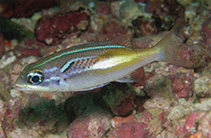
Épines dorsales (Total) : 10; Rayons mous dorsaux (Total) : 9; Épines anales: 3; Rayons mous anaux: 7. Head scales reaching forward to between level of anterior margin of eyes and posterior nostrils. Lower limb of preopercle scaly. Antrorse (forward-directed) suborbital spine present beneath eye. Pelvic fins moderately long, reaching to or almost to level of anus. Color: Upper body greyish-brown, silvery-white below. A pearly-blue streak from behind eye along dorsal fin base. An oblique, brown-edged pearly-blue bar above the pectoral base. An elongate white blotch below lateral line on posterior half of body, a yellowish tinge above this blotch. Snout dusky and a black blotch on opercle.
Body shape (shape guide): fusiform / normal; Cross section: oval.
Inhabits coastal waters around rocky-rubble and seaweed areas of coral reefs, outer slopes and lagoons. Usually in small groups but may be seen solitary (Ref. 48635, 90102). Feeds mainly on benthic crustaceans.
Life cycle and mating behavior
Maturité | Reproduction | Frai | Œufs | Fécondité | Larves
Russell, B.C., 1990. FAO Species Catalogue. Vol. 12. Nemipterid fishes of the world. (Threadfin breams, whiptail breams, monocle breams, dwarf monocle breams, and coral breams). Family Nemipteridae. An annotated and illustrated catalogue of nemipterid species known to date. FAO Fish. Synop. 125(12):149p. Rome: FAO. (Ref. 3810)
Statut dans la liste rouge de l'IUCN (Ref. 130435: Version 2025-1)
Menace pour l'homme
Harmless
Utilisations par l'homme
Pêcheries: pêcheries vivrières
Outils
Articles particuliers
Télécharger en XML
Sources Internet
Estimates based on models
Preferred temperature (Réf.
123201): 26.9 - 29, mean 28.2 °C (based on 908 cells).
Phylogenetic diversity index (Réf.
82804): PD
50 = 0.5000 [Uniqueness, from 0.5 = low to 2.0 = high].
Bayesian length-weight: a=0.01660 (0.00747 - 0.03689), b=2.98 (2.81 - 3.15), in cm total length, based on LWR estimates for this Genus-body shape (Ref.
93245).
Niveau trophique (Réf.
69278): 3.4 ±0.43 se; based on food items.
Résilience (Réf.
120179): Haut, temps minimum de doublement de population inférieur à 15 mois (Preliminary K or Fecundity.).
Fishing Vulnerability (Ref.
59153): Low vulnerability (12 of 100).
🛈
Nutrients (Ref.
124155): Calcium = 69.1 [41.3, 140.0] mg/100g; Iron = 0.721 [0.357, 1.684] mg/100g; Protein = 18.9 [17.1, 20.6] %; Omega3 = 0.157 [0.095, 0.262] g/100g; Selenium = 29.5 [17.8, 53.2] μg/100g; VitaminA = 77.2 [21.9, 225.0] μg/100g; Zinc = 1.39 [0.96, 2.02] mg/100g (wet weight);