>
Syngnathiformes (Pipefishes and seahorses) >
Syngnathidae (Pipefishes and seahorses) > Syngnathinae
Etymology: Halicampus: Greek, als, alis = salt + Greek, kampe = bend (Ref. 45335).
More on author: Günther.
Environment: milieu / climate zone / rango de profundidad / distribution range
Ecología
marino asociado a arrecife; rango de profundidad 1 - 20 m (Ref. 90102). Tropical; 30°N - 23°S
Western Pacific: Viet Nam to Fiji, north to Ryukyu Islands, south to Rowley Shoals and New Caledonia; Belau in Micronesia.
Tamaño / Peso / Age
Madurez: Lm ? range ? - ? cm
Max length : 7.3 cm SL macho / no sexado; (Ref. 1602)
Short description
Claves de identificación | Morfología | Morfometría
Espinas dorsales (total) : 0; Radios blandos dorsales (total) : 18 - 22; Espinas anales: 0; Radios blandos anales: 3. Superior trunk and tail ridges discontinuous; inferior trunk ridge ending at anal ring; lateral trunk ridge continuous with inferior tail ridge; body rings 13-15 + 30-32.
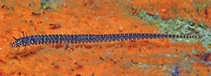
Body shape (shape guide): eel-like; Cross section: angular.
Adults inhabit reef flats to a depth of over 17 m. Easily recognized by color but secretive and not often seen (Ref. 48635). Ovoviviparous (Ref. 205). The male carries the eggs in a brood pouch which is found under the tail (Ref. 205). Also seen in coral reefs in 1-20 m (Ref 90102).
Life cycle and mating behavior
Madurez | Reproducción | Puesta | Huevos | Fecundidad | Larva
Male carries the eggs in a brood pouch (Ref. 205).
Myers, R.F., 1991. Micronesian reef fishes. Second Ed. Coral Graphics, Barrigada, Guam. 298 p. (Ref. 1602)
IUCN Red List Status (Ref. 130435: Version 2025-1)
Threat to humans
Harmless
Human uses
Herramientas
Special reports
Download XML
Fuentes de Internet
Estimates based on models
Preferred temperature (Referencia
123201): 25.6 - 29.3, mean 28.6 °C (based on 1778 cells).
Phylogenetic diversity index (Referencia
82804): PD
50 = 0.5002 [Uniqueness, from 0.5 = low to 2.0 = high].
Bayesian length-weight: a=0.00037 (0.00016 - 0.00085), b=3.18 (2.99 - 3.37), in cm total length, based on LWR estimates for this (Sub)family-body shape (Ref.
93245).
Nivel trófico (Referencia
69278): 3.2 ±0.5 se; based on size and trophs of closest relatives
Resiliencia (Referencia
120179): Alto, población duplicada en un tiempo mínimo inferior a 15 meses (Preliminary K or Fecundity.).
Fishing Vulnerability (Ref.
59153): Low vulnerability (10 of 100).
🛈
Nutrients (Ref.
124155): Calcium = 217 [117, 481] mg/100g; Iron = 1.28 [0.64, 2.30] mg/100g; Protein = 17.8 [16.5, 19.0] %; Omega3 = 0.12 [0.06, 0.25] g/100g; Selenium = 35.6 [15.0, 91.4] μg/100g; VitaminA = 78.4 [22.3, 266.1] μg/100g; Zinc = 2.66 [1.64, 4.04] mg/100g (wet weight);