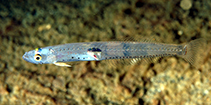
Crystallogobius linearis, Crystal goby

You can sponsor this page

Crystallogobius linearis (Düben, 1845)

Crystal goby
Adicionar sua observação em Fish Watcher
Native range | All suitable habitat | Point map | Year 2050
This map was computer-generated and has not yet been reviewed.
Crystallogobius linearis   AquaMaps   Data sources: GBIF OBIS
Carregue seu(sua) Fotos e vídeos
Fotos | Imagem do Google
Image of Crystallogobius linearis (Crystal goby)
Crystallogobius linearis
Foto de Svensen, R.

Classificação / Nomes Nomes comuns | Sinônimos | Catalog of Fishes(Gênero, Espécies) | ITIS | CoL | WoRMS | Cloffa

> Gobiiformes (Gobies) > Gobiidae (Gobies) > Gobionellinae
Etymology: Crystallogobius: Latin, cristallum = ice + Latin, gobius = gudgeon (Ref. 45335).

Environment: milieu / Zona climática / intervalo de profundidade / distribution range Ecologia

marinhas demersal; não migratória (Ref. 4696); intervalo de profundidade 1 - 400 m (Ref. 35388). Temperate; 70°N - 35°N, 11°W - 25°E

Distribuição Países | Áreas da FAO | Ecossistemas | Ocorrências | Mapa de pontos | Introduções | Faunafri

Eastern Atlantic: Lofotens, Norway, to Gibraltar. Also known from the Mediterranean Sea. Eastern Central Atlantic: Madeira Island (Ref. 74541).

Tamanho / Peso / Idade

Maturidade: Lm ?  range ? - ? cm
Max length : 4.7 cm SL macho/indeterminado; (Ref. 4696); 3.9 cm SL (female); idade máx. registrada: 1.00 anos (Ref. 232)

Descrição suscinta Chaves de identificação | Morfologia | Morfometria

Espinhos dorsais (total) : 2 - 3; Raios dorsais (total) : 18 - 20; Espinhos anais: 1; Raios anais : 20 - 21. Patterns of sensory papillae require detailed description. Pronounced sexual dimorphism. Anterior nostril a short tube. Pectoral fin uppermost rays within membrane. Males: with prominent front canine teeth; pelvic disc complete and deep; 1st dorsal with only 2 with rays. Females: pelvic disc reduced or lacking; 1st dorsal absent or rudimentary. Vertebrae 30(29-31).
Body shape (shape guide): elongated.

Biologia     Glossário (p.ex. epibenthic)

Benthic and free swimming (Ref. 92840). This occasionally territorial species occurs in coastal waters, over shell, sand, or mud bottoms; males bottom-living during breeding season. Feed on zooplankton (Ref. 5204). Spawning takes place when 1 year old. Adults die afterwards. Eggs are laid in the empty tube-worms and are guarded by the male (Ref. 35388). Eggs are pear-shaped (Ref. 4696).

Ciclo de vida ou comportamento de acasalamento Maturidade | Reprodução | Desova | Ovos | Fecundidade | Larvas

Males guard eggs in empty tubes of larger worms, such as Chaetopterus. Adults die after breeding (Ref. 4696).

Referência principal Carregar suas referências | Referências | Coordenador | Colaboradores

Wheeler, A., 1992. A list of the common and scientific names of fishes of the British Isles. J. Fish Biol. 41(suppl.A):1-37. (Ref. 5204)

Status na Lista Vermelha da UICN (Ref. 130435: Version 2025-1)

  Segura ou pouco preocupante (LC) ; Date assessed: 19 March 2024

CITES

Not Evaluated

CMS (Ref. 116361)

Not Evaluated

Ameaça para os humanos

  Harmless


Uso pelos humanos

Pescarias: sem interesse
FAO - Publication: search | FishSource |

Mais informação

Ecologia Trófica
Food items (preys)
Composição da dieta
Consumo alimentar
Food rations
Predadores
Ecologia
Ecologia
Home ranges
Population dynamics
Parâmetros de crescimento
Max. ages / sizes
Length-weight rel.
Length-length rel.
Frequências de comprimento
Conversão de massa
Recrutamento
Abundância
Life cycle
Reprodução
Maturidade
Maturity/Gills rel.
Fecundidade
Desova
Spawning aggregations
Ovos
Desenvolvimento dos ovos
Larvas
Dinâmica larval
Distribuição
Países
Áreas da FAO
Ecossistemas
Ocorrências
Introduções
BRUVS - Videos
Anatomy
Área branquial
Brain
Otolith
Physiology
Body composition
Nutrients
Consumo de oxigênio
Tipo de natação
Velocidade de natação
Visual pigments
Fish sound
Diseases & Parasites
Toxicity (LC50s)
Genética
genoma
Genética
Heterozygosity
Hereditariedade
Human related
Aquaculture systems
Perfis para aquacultura
Estirpes
Ciguatera cases
Stamps, coins, misc.
Outreach
Colaboradores
Taxonomy
Nomes comuns
Sinônimos
Morfologia
Morfometria
Fotos
Referências
Referências

Ferramentas

Relatórios especiais

Baixar XML

Fontes da internet

Estimates based on models

Preferred temperature (Ref. 123201): 6.8 - 14.3, mean 9.8 °C (based on 546 cells).
Índice de diversidade filogenética (Ref. 82804):  PD50 = 1.0000   [Uniqueness, from 0.5 = low to 2.0 = high].
Bayesian length-weight: a=0.00724 (0.00338 - 0.01553), b=3.05 (2.87 - 3.23), in cm total length, based on LWR estimates for this (Sub)family-body shape (Ref. 93245).
Nível Trófico (Ref. 69278):  3.4   ±0.45 se; based on food items.
Generation time: 1.1 ( na - na) years. Estimated as median ln(3)/K based on 1 growth studies.
Resiliência (Ref. 120179):  médio(a), tempo mínimo de duplicação da população 1,4 - 4,4 anos (tm=1; tmax=1; Fec=340).
Fishing Vulnerability (Ref. 59153):  Low vulnerability (14 of 100). 🛈
Nutrients (Ref. 124155):  Calcium = 156 [75, 491] mg/100g; Iron = 0.658 [0.278, 1.486] mg/100g; Protein = 17 [15, 19] %; Omega3 = 0.567 [0.214, 1.379] g/100g; Selenium = 12.1 [4.5, 34.6] μg/100g; VitaminA = 49.2 [10.7, 235.1] μg/100g; Zinc = 1.07 [0.65, 1.76] mg/100g (wet weight);