Teleostei (teleosts) >
Beloniformes (Needle fishes) >
Zenarchopteridae (Internally fertilized halfbeaks)
Etymology: Nomorhamphus: Greek, nema = filament + Greek, rhamphos = bill, peak (Ref. 45335); kolonodalensis: Named for Kolonodale region of Sulawesi, where most specimens were collected.
Environment: milieu / climate zone / depth range / distribution range
Ecology
Freshwater; pelagic; depth range 0 - ? m. Tropical
Asia: Indonesia.
Length at first maturity / Size / Weight / Age
Maturity: Lm ?, range 7 - ? cm
Max length : 6.8 cm SL male/unsexed; (Ref. 45130)
Short description
Identification keys | Morphology | Morphometrics
Dorsal soft rays (total): 10 - 12; Anal soft rays: 10 - 12; Vertebrae: 37 - 39. Differs from N. towoetii and N. celebensis which are also found in Kolonodale in having a short lower jaw 8.8-22.2 times in SL (versus upper and lower jaws about the same length); long upper jaw (length/width 1.1-2.1 versus 0.7-1.3). Gill rakers teardrop shaped usually without teeth (versus with many teeth). Fifth hypural partially separate from dorsal hypural plate along most of its length (versus completely fused) (Ref. 45130).
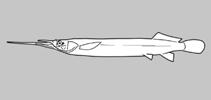
Body shape (shape guide): elongated; Cross section: compressed.
A viviparous species collected from a variety of habitats including small, clear, cool mountain streams with rocky, muddy bottoms; shallow pools (0.02-0.50 m); muddy shorelines among tangles of roots; the base of small waterfalls among reeds; and under riverine canopies. (Ref. 45130).
Life cycle and mating behavior
Maturity | Reproduction | Spawning | Eggs | Fecundity | Larvae
Meisner, A.D. and K.D. Louie, 2000. Nomorhamphus kolonodalensis, a new species of viviparous halfbeak from Sulawesi (Teleostei: Hemiramphidae). Ichthyol. Explor. Freshwat. 11(4):361-368. (Ref. 45130)
IUCN Red List Status (Ref. 130435: Version 2025-1)
Threat to humans
Harmless
Human uses
Tools
Special reports
Download XML
Internet sources
Estimates based on models
Phylogenetic diversity index (Ref.
82804): PD
50 = 0.5000 [Uniqueness, from 0.5 = low to 2.0 = high].
Bayesian length-weight: a=0.00457 (0.00200 - 0.01044), b=3.03 (2.82 - 3.24), in cm total length, based on LWR estimates for this (Sub)family-body shape (Ref.
93245).
Trophic level (Ref.
69278): 3.1 ±0.4 se; based on size and trophs of closest relatives
Fishing Vulnerability (Ref.
59153): Low vulnerability (10 of 100).
🛈