Klassifizierung / Names
Namen | Synonyme | Catalog of Fishes(Gattung, Arten) | ITIS | CoL | WoRMS | Cloffa
>
Perciformes/Cottoidei (Sculpins) >
Liparidae (Snailfishes)
Etymology: Paraliparis: Greek, para = the side of + Greek, liparis = fat (Ref. 45335); skeliphrus: The specific epithet, "skeliphrus" from the masculine Greek adjective "dry-looking" because the specimen has clearly dried out at some previous time.
More on author: Stein.
Environment: milieu / climate zone / Tiefenbereich / distribution range
Ökologie
seewasser bathypelagisch; tiefenbereich 1400 - 1475 m (Ref. 54940). Deep-water
Verbreitung
Länder | FAO Gebiete | Ecosystems | Vorkommen | Punkt Karte | Einführungen | Faunafri
Southeastern Pacific: Off Antofagasta, Chile, where it is apparently benthic or epibenthic.
Size / Gewicht / Alter
Geschlechtsreife: Lm ? range ? - ? cm
Max length : 7.1 cm SL (female)
Kurzbeschreibung
Bestimmungsschlüssel | Morphologie | Morphometrie
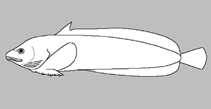
A Paraliparis distinguished by the following combination of characters: V53, mouth horizontal, P 22 (14+4+4), rudimentary rays absent, notch rays distinctly more widely spaced than either upper or lower lobe rays, posterior angle of mouth reaching below or slightly behind rear margin of orbit, directly above anteriormost pectoral fin ray, gill cavity pale.
Body shape (shape guide): elongated.
Life cycle and mating behavior
Geschlechtsreife | Fortpflanzung | Ablaichen | Eier | Fecundity | Larven
Stein, D.L., 2005. Descriptions of four new species, redescription of Paraliparis membranaceus, and additional data on species of the fish family Liparidae (Pisces, Scorpaeniformes) from the west coast of South America and the Indian Ocean. Zootaxa 1019:1-25. (Ref. 54940)
IUCN Rote Liste Status (Ref. 130435: Version 2025-1)
Bedrohung für Menschen
Harmless
Nutzung durch Menschen
Fischereien: nicht kommerziell
Tools
Zusatzinformationen
Download XML
Internet Quellen
Estimates based on models
Phylogenetic diversity index (Ref.
82804): PD
50 = 0.5000 [Uniqueness, from 0.5 = low to 2.0 = high].
Bayesian length-weight: a=0.00525 (0.00237 - 0.01161), b=3.15 (2.96 - 3.34), in cm total length, based on LWR estimates for this (Sub)family-body shape (Ref.
93245).
Trophic level (Ref.
69278): 3.3 ±0.5 se; based on size and trophs of closest relatives
Widerstandsfähigkeit (Ref.
120179): hoch, Verdopplung der Population dauert weniger als 15 Monate. (Preliminary K or Fecundity.).
Fishing Vulnerability (Ref.
59153): Low vulnerability (10 of 100).
🛈