Classification / Names
Nombres comunes | Sinónimos | Catalog of Fishes(Género, Especie) | ITIS | CoL | WoRMS | Cloffa
>
Siluriformes (Catfishes) >
Anchariidae (Vaonas)
Etymology: Gogo: Gogo is the Malagasy word most commonly used to refer to members of Anchariidae; ornatus: The specific epithet comes from the Latin ornatus, meaning in splendid dress, in reference to its colouration (Ref. 56142).
Environment: milieu / climate zone / rango de profundidad / distribution range
Ecología
; agua dulce demersal. Temperate
Africa: Mangoro River drainage on east coast of Madagascar (Ref. 56142).
Tamaño / Peso / Age
Madurez: Lm ? range ? - ? cm
Max length : 21.2 cm SL macho / no sexado; (Ref. 56142)
Short description
Claves de identificación | Morfología | Morfometría
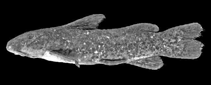
Espinas dorsales (total) : 2; Radios blandos dorsales (total) : 6 - 7; Espinas anales: 0; Radios blandos anales: 12; Vértebra: 43 - 46. Diagnosis: Gogo ornatus is distinguished from other members of Anchariidae by a highly mottled pigmentation pattern consisting of contrasting light and dark patches vs. uniform colouration with or without isolated small scattered dark spots or subtle mottled brownish-gray colouration (Ref. 56142). It can be further distinguished from Gogo brevibarbis in having unicuspid teeth on the upper and lower jaws vs. bicuspid; and a smaller eye, 9.2-13.6% of head length vs. 15.9% (Ref. 56142). It can be distinguished from Gogo arcuatus in having a smaller eye, 9.2-13.6% of head length vs. 17.7-18.0%; and a straight dorsoposterior margin of the dorsal fin vs. concave (Ref. 56142).
Body shape (shape guide): fusiform / normal.
Found in a clear, clean, and well oxygenated river with a substrate composed of sand and gravel, with large scattered boulders (Ref. 56142).
Life cycle and mating behavior
Madurez | Reproducción | Puesta | Huevos | Fecundidad | Larva
Ng, H.H. and J.S. Sparks, 2005. Revision of the endemic Malagasy catfish family Anchariidae (Teleostei: Siluriformes), with descriptions of a new genus and three new species. Ichthyol. Explor. Freshwat. 16(4):303-323. (Ref. 56142)
IUCN Red List Status (Ref. 130435: Version 2025-1)
Threat to humans
Harmless
Human uses
Herramientas
Special reports
Download XML
Fuentes de Internet
Estimates based on models
Phylogenetic diversity index (Referencia
82804): PD
50 = 0.5781 [Uniqueness, from 0.5 = low to 2.0 = high].
Bayesian length-weight: a=0.00389 (0.00180 - 0.00842), b=3.12 (2.94 - 3.30), in cm total length, based on all LWR estimates for this body shape (Ref.
93245).
Nivel trófico (Referencia
69278): 3.4 ±0.5 se; based on size and trophs of closest relatives
Fishing Vulnerability (Ref.
59153): Low vulnerability (16 of 100).
🛈