Teleostei (teleosts) >
Beloniformes (Needle fishes) >
Adrianichthyidae (Ricefishes) > Oryziinae
Etymology: Oryzias: Greek, oryza = rice; because of the habitat used by this fish (Ref. 45335).
Environment: milieu / climate zone / depth range / distribution range
Ecology
Freshwater; benthopelagic; pH range: 7.5 - 8.5; non-migratory. Tropical; 22°C - 25°C (Ref. 31267)
Asia: Indonesia.
Size / Weight / Age
Maturity: Lm ? range ? - ? cm
Max length : 4.1 cm SL male/unsexed; (Ref. 85098)
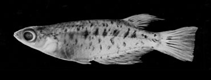
Dorsal soft rays (total): 9 - 10; Anal soft rays: 22 - 25. This species is distinguished (from O. profundicola, O. loxolepis) by the following characters: abdominal vertebrae usually 12, total vertebrae 29-31; D 9-10, A 22-25; transverse scales 10-11; body depth at anal-fin origin 24.8-30.1% SL and at dorsal-fin origin 20.2-25.3% SL; caudal peduncle length 12.0-16.3% SL; distinct nuchal concavity; lateral scales are more-or-less aligned parallel to midlateral stripe; male with elongated-shaped dorsal fin without yellow margin (Ref. 133090).
Cross section: compressed.
Non-annual breeder. Is very difficult to maintain in aquarium (Ref. 27139). In 2013 and 2018, the collected and observed specimens were only during the day and at TanjungTimbala, slightly south of the type locality, and at Lengkona in Lake Towuti. This species is collected with O. loxolepis and O. profundicola that form schools in gently sloping, shallow (< 1.5 m) shore areas with large boulders and submerged wood over sand and gravel. Other taxa occurring in samples included Paratherina spp., Glossogobius flavipinnis, G. intermedius, Glossogobius sp., Mugilogobius rexi, M. latifrons, and Nomorhamphus megarrhamphus. In Lake Lantoa, it inhabits gently sloping, shallow shores (1 m depth) with a large area of plants on a muddy substratum. It swims in schools and was collected in association with Telmatherina celebensis and Glossogobius sp. (an undescribed lake endemic: HK, pers. obsv.). Some individuals were infested with parasitic copepods. In Lake Mahalona, it also inhabits gently sloping, shallow shores (1 m depth) with large boulders over a sand and gravel substratum, covered with aquatic vegetation. Often, it also forms schools and co-occurring with Tominanga aurea, Glossogobius sp. (as for Lake Towuti), Glossogobius mahalonensis, G. intermedius, M. rexi, and Mugilogobius cf. hitam (Ref. 133093).
Life cycle and mating behavior
Maturity | Reproduction | Spawning | Eggs | Fecundity | Larvae
Egg clusters are carried by females under the ventral fin (Ref. 26687).
Kottelat, M., A.J. Whitten, S.N. Kartikasari and S. Wirjoatmodjo, 1993. Freshwater fishes of Western Indonesia and Sulawesi. Periplus Editions, Hong Kong. 221 p. (Ref. 7050)
IUCN Red List Status (Ref. 130435: Version 2025-1)
Threat to humans
Harmless
Human uses
Fisheries: commercial; aquarium: commercial
Tools
Special reports
Download XML
Internet sources
Estimates based on models
Phylogenetic diversity index (Ref.
82804): PD
50 = 0.5000 [Uniqueness, from 0.5 = low to 2.0 = high].
Bayesian length-weight: a=0.00479 (0.00189 - 0.01213), b=3.13 (2.91 - 3.35), in cm total length, based on LWR estimates for this (Sub)family-body shape (Ref.
93245).
Trophic level (Ref.
69278): 3.4 ±0.4 se; based on size and trophs of closest relatives
Resilience (Ref.
120179): Low, minimum population doubling time 4.5 - 14 years (Assuming fec < 100, egg cluster of 13-15 eggs).
Fishing Vulnerability (Ref.
59153): Low vulnerability (10 of 100).
🛈