>
Mugiliformes (Mullets) >
Mugilidae (Mullets)
Etymology: Pseudomyxus: Name from the genus Myxus preceeded by Greek prefix 'pseudo' meaning 'false'.
More on author: Valenciennes.
Environment: milieu / climate zone / intervalo de profundidade / distribution range
Ecologia
marinhas; Água doce; estuarina demersal; catádromo (Ref. 51243). Subtropical; 25°S - 35°S
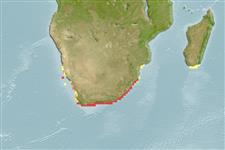
Africa: endemic to South Africa, in east coastal estuaries and rivers from the Breë River to Kosi Bay (Ref. 7248, 52193).
Length at first maturity / Tamanho / Peso / Idade
Maturidade: Lm 23.0 range ? - ? cm
Max length : 45.0 cm FL macho/indeterminado; (Ref. 52193)
Descrição breve
Chaves de identificação | Morfologia | Morfometria
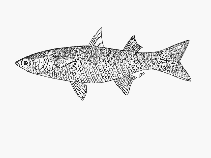
Espinhos dorsais (total) : 5; Raios dorsais moles (total) : 8; Espinhos anais: 3; Raios anais moles: 9.
Body shape (shape guide): fusiform / normal.
Adults occur in freshwater to estuarine conditions. Adults breed at sea, throughout the year; juveniles move into estuaries and enter rivers usually in late winter or early spring (Ref. 52193). Females remain in freshwater for 7 years, males for 4 years (Ref. 52193). Return to estuaries before maturing sexually prior to spawning (Ref. 52193). Oviparous, eggs are pelagic and non-adhesive (Ref. 205). Feed on benthic algae and small invertebrates over muddy bottom (Ref. 6465). Decline in population from obstruction, by dams and weirs, of free passage into rivers.
Life cycle and mating behavior
Maturidade | Reprodução | Desova | Ovos | Fecundidade | Larvas
Breed at the sea throughout the year. Juveniles move into estuaries and enter rivers usually in late winter or early spring. Males remain in freshwater until 4 years, females for up to 7 years. Fish return first to estuaries before maturing sexually prior to spawning (Ref. 7248).
Thomson, J.M., 1986. Mugilidae. p. 344-349. In J. Daget, J.-P. Gosse and D.F.E. Thys van den Audenaerde (eds.) Check-list of the freshwater fishes of Africa (CLOFFA). ISNB, Brussels, MRAC; Tervuren; and ORSTOM, Paris. Vol. 2. (Ref. 3573)
Categoria na Lista Vermelha da IUCN (Ref. 130435: Version 2025-1)
Ameaça para o homem
Harmless
Utilização humana
Pescarias: espécies comerciais; Aquário: Espécies comerciais
Ferramentas
Relatórios especiais
Descarregue XML
Fontes da internet
Estimates based on models
Preferred temperature (Ref.
123201): 15.3 - 24.9, mean 22.6 °C (based on 20 cells).
Phylogenetic diversity index (Ref.
82804): PD
50 = 1.0000 [Uniqueness, from 0.5 = low to 2.0 = high].
Bayesian length-weight: a=0.01175 (0.00668 - 0.02065), b=2.97 (2.82 - 3.12), in cm total length, based on LWR estimates for this species & (Sub)family-body (Ref.
93245).
Nível Trófico (Ref.
69278): 2.8 ±0.27 se; based on food items.
Resiliência (Ref.
120179): Médio, tempo mínimo de duplicação da população 1,4 - 4,4 anos (Preliminary K or Fecundity.).
Fishing Vulnerability (Ref.
59153): Moderate vulnerability (40 of 100).
🛈