Elasmobranquios (tiburones y rayas) (sharks and rays) >
Squaliformes (Sleeper and dogfish sharks) >
Squalidae (Dogfish sharks)
Etymology: Squalus: Genus name from Latin 'squalus' meaning shark (Ref. 6885, 27436).
More on authors: White, Last & Yearsley.
Environment: milieu / climate zone / rango de profundidad / distribution range
Ecología
marino bentopelágico; rango de profundidad 1 - 100 m (Ref. 58445). Tropical
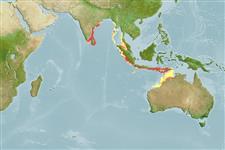
Eastern Indian Ocean.
Length at first maturity / Tamaño / Peso / Age
Madurez: Lm ?, range 43 - ? cm
Max length : 52.2 cm TL macho / no sexado; (Ref. 58445); 78.0 cm TL (female)
Short description
Claves de identificación | Morfología | Morfometría
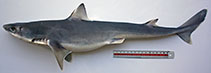
This species is distinguished by the following set of characters: slender body of moderate size, depth 9-10.6% TL; relatively narrow and very short snout, horizontal prenarial length is 8.4-9.1% TL; large eyes, length 5.1-5.6% TL; secondary lobe of anterior nasal flap is well developed; small dorsal fins that are strongly raked; first dorsal-fin spine is moderate, broad-based while the second dorsal-fin spine is moderate, robust and broad-based; weakly falcate pectoral fin in adults its inner margin relatively short, 6.9-7.8% TL; caudal fin with a short, broad caudal bar, enlarged upper caudal blotch and the fringe is located distally on lobe in juveniles; flank denticles are broadly unicuspidate to weakly tricuspidate; monospondylous centra 35-38, precaudal centra 72-76, total centra 96-100 (Ref. 58445).
Body shape (shape guide): elongated.
Apparently occurs on or near the bottom of upper continental and insular slopes, but depth distribution is undetermined; probably on shallower water than its congeners. Presumably feeds on small fishes, cephalopods and crustaceans. Viviparous, with yolk-sac dependency. Gives birth to 3 -10 pups, but gestation period is unknown. Males mature at about 43 cm TL and females by 61 cm TL; with largest embryo measured at 18 cm. The species is a very common catch component fo the demersal longline fishery in deepwater areas in eastern Indonesia. It is caught for its meat, fins and liver oil (Ref. 58042).
Life cycle and mating behavior
Madurez | Reproducción | Puesta | Huevos | Fecundidad | Larva
Distinct pairing with embrace (Ref. 205).
White, W.T., P.R. Last and G.K. Yearsley, 2007. Squalus hemipinnis sp. Nov., a new short-snout spurdog from eastern Indonesia. pp. 101-108. In P.R. Last, W.T. White and J.J. Pogonoski Descriptions of new dogfishes of the genus Squalus (Squaloidea: Squalidae). CSIRO Marine and Atmospheric Research Paper No. 014. 130 pp. (Ref. 58445)
IUCN Red List Status (Ref. 130435: Version 2025-1)
Threat to humans
Harmless
Human uses
Pesquerías: de interés potencial
Herramientas
Special reports
Download XML
Fuentes de Internet
Estimates based on models
Preferred temperature (Referencia
123201): 25.6 - 28.7, mean 28.3 °C (based on 20 cells).
Phylogenetic diversity index (Referencia
82804): PD
50 = 0.5000 [Uniqueness, from 0.5 = low to 2.0 = high].
Bayesian length-weight: a=0.00347 (0.00165 - 0.00730), b=3.09 (2.92 - 3.26), in cm total length, based on LWR estimates for this Genus-body shape (Ref.
93245).
Nivel trófico (Referencia
69278): 4.3 ±0.3 se; based on size and trophs of closest relatives
Resiliencia (Referencia
120179): Bajo, población duplicada en un tiempo mínimo de 4.5-14 años (Preliminary K or Fecundity.).
Fishing Vulnerability (Ref.
59153): Moderate to high vulnerability (51 of 100).
🛈