



Benthobatis yangi Carvalho, Compagno & Ebert, 2003
Taiwanese blind electric ray
Upload your photos and videos
Google image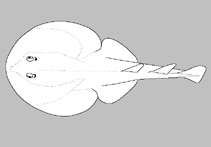 No image available for this species;
drawing shows typical species in Narcinidae.
Google image
drawing shows typical species in Narcinidae.
Classification / Names Common names | Synonyms | Catalog of Fishes(genus, species) | ITIS | CoL | WoRMS | Cloffa
Elasmobranchii (sharks and rays) > Torpediniformes (Electric rays) > Narcinidae (Numbfishes)
Etymology: Benthobatis: Greek, benthos = depth of the sea + Greek, batis, -idos = a ray (Raja sp.) (Ref. 45335); yangi: Named for Hung-Chia Yang, Taiwanese Fisheries Research Institute in Kao-Hsiung.
Eponymy: Hung-Chia (Hung-Jia) Yang was an ichthyologist and highly talented illustrator working at the Taiwanese Fisheries Research Institute, Kaohsiung. [...] (Ref. 128868), visit book page.
Etymology: Benthobatis: Greek, benthos = depth of the sea + Greek, batis, -idos = a ray (Raja sp.) (Ref. 45335); yangi: Named for Hung-Chia Yang, Taiwanese Fisheries Research Institute in Kao-Hsiung.
Eponymy: Hung-Chia (Hung-Jia) Yang was an ichthyologist and highly talented illustrator working at the Taiwanese Fisheries Research Institute, Kaohsiung. [...] (Ref. 128868), visit book page.
Environment: milieu / climate zone / depth range / distribution range Ecology
Marine; bathydemersal; depth range ? - 300 m (Ref. 114953). Temperate
Distribution Territories | FAO areas | Ecosystems | Occurrences | Point map | Introductions | Faunafri
Northwest Pacific: Taiwan.
Length at first maturity / Size / Weight / Age
Short description Identification keys | Morphology | Morphometrics
This species is distinguished from all its congeners by the following unique set of characters: both dorsal and ventral surfaces dark brown to purplish-black, with irregular whitish blotches ventrally; narrow nasoral region, with relatively small mouth, slender jaws and shallow circumoral groove; relatively small spiracles; very narrow gill-slits; the second dorsal fin is slightly larger than first, with more slanted anterior margin, broadly rounded apex, and convex posterior margin; low caudal fin, relatively elongated; interdorsal distance greater than distance between second dorsal and caudal fin; suprascapula very narrow and not arched posteriorly; males sexually mature between 19.1-21.5 cm TL; relatively high number of caudal vertebral centra (38-46), total vertebral centra (116-120) (Ref. 75959).
Body shape (shape guide): other.
Body shape (shape guide): other.
A benthic species found on continental slope. Mainly feeds on polychaete worms (Ref. 114953). Stomach contents include mud and the partial remains of an unidentified polychaete worm, plus unattached polychaete bristles and unidentified small white objects (Ref. 75959). Maturity size of males at 16-19 cm TL (Ref. 114953).
Life cycle and mating behavior Maturity | Reproduction | Spawning | Eggs | Fecundity | Larvae
Main reference
Upload your references | References | Coordinator : Carvalho, Marcelo | Collaborators
de Carvalho, M.R., L.J.V. Compagno and D.A. Ebert, 2003. Benthobatis yangi, a new species of blind electric ray from Taiwan (Chondrichthyes: Torpediniformes: Narcinidae). Bull. Mar. Sci. 72(3):923-939. (Ref. 75959)
IUCN Red List Status (Ref. 130435: Version 2025-2 (Global))
Vulnerable (VU) (A2d); Date assessed: 29 August 2019
CITES
Not Evaluated
Threat to humans
Harmless
Human uses
FAO - Publication: search | FishSource |
More information
Ecology
Ecology
Ecology
Population dynamics
Growth parameters
Max. ages / sizes
Length-weight rel.
Length-length rel.
Length-frequencies
Mass conversion
Recruitment
Abundance
Growth parameters
Max. ages / sizes
Length-weight rel.
Length-length rel.
Length-frequencies
Mass conversion
Recruitment
Abundance
Life cycle
Reproduction
Maturity
Maturity/Gills rel.
Fecundity
Spawning
Spawning aggregations
Eggs
Egg development
Larvae
Larval dynamics
Reproduction
Maturity
Maturity/Gills rel.
Fecundity
Spawning
Spawning aggregations
Eggs
Egg development
Larvae
Larval dynamics
Anatomy
Gill area
Brain
Otolith
Gill area
Brain
Otolith
Physiology
Body composition
Nutrients
Oxygen consumption
Swimming type
Swimming speed
Visual pigments
Fish sound
Diseases & Parasites
Toxicity (LC50s)
Body composition
Nutrients
Oxygen consumption
Swimming type
Swimming speed
Visual pigments
Fish sound
Diseases & Parasites
Toxicity (LC50s)
Genetics
Genome
Genetics
Heterozygosity
Heritability
Genetic Diversity
Genome
Genetics
Heterozygosity
Heritability
Genetic Diversity
Human related
Aquaculture systems
Aquaculture profiles
Strains
Ciguatera cases
Stamps, coins, misc.
Aquaculture systems
Aquaculture profiles
Strains
Ciguatera cases
Stamps, coins, misc.
Tools
Special reports
Download XML
Internet sources
AFORO (otoliths) | Aquatic Commons | BHL | Cloffa | Websites from users | Check FishWatcher | CISTI | Catalog of Fishes: genus, species | DiscoverLife | ECOTOX | FAO - Publication: search | Faunafri | Fishipedia | Fishtrace | GloBI | Google Books | Google Scholar | Google | IGFA World Record | National databases | OneZoom | Open Tree of Life | Otolith Atlas of Taiwan Fishes | PubMed | Reef Life Survey | Socotra Atlas | TreeBase | Tree of Life | Wikipedia: Go, Search | World Records Freshwater Fishing | Zoobank | Zoological Record
Estimates based on models
|
Phylogenetic diversity index (Ref. 82804) |
PD50 = 0.5625 [Uniqueness, from 0.5 = low to 2.0 = high]. |
| Bayesian length-weight | a=0.01175 (0.00470 - 0.02937), b=2.88 (2.66 - 3.10), in cm total length, based on LWR estimates for this (Sub)family-body shape (Ref. 93245). |
|
Trophic level (Ref. 69278) |
3.2 ±0.4 se; based on size and trophs of closest relatives |
|
Fishing Vulnerability (Ref. 59153) |
Low vulnerability (11 of 100). 🛈 |