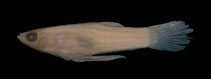
Классификация / Names
народные названия | синонимы | Catalog of Fishes(род, виды) | ITIS | CoL | WoRMS | Cloffa
>
Cyprinodontiformes (Rivulines, killifishes and live bearers) >
Poeciliidae (Poeciliids) > Poeciliinae
Etymology: Phalloceros: Greek, phallos = penis + Greek, keras = horn (Ref. 45335); elachistos: Specific name from the Greek elachis, small, short, little, plus the superlative ending -istos. Elachistos meaning the least, which alludes to the small size of the specimens. An adjective, gender masculine.
Environment: milieu / climate zone / пределы глубины / distribution range
экология
; пресноводный пелагический. Tropical
South America: Brazil: Drainages of rio Doce, Santa Maria da Vitória, Jucu, and Timbuí, coastal drainages of Espírito Santo State of Brazil.
Size / Вес / Возраст
половая зрелость: Lm ? range ? - ? cm
Max length : 2.0 cm SL самец/пол неопределен; (Ref. 76852); 2.8 cm SL (female)
Краткое описание
определительные ключи | морфология | морфометрия
членистые (мягкие) лучи спинного плавника (общее число) : 7 - 9; членистые (мягкие) лучи анального плавника: 8 - 11; позвонки: 31 - 33. Can be separated from Phalloceros anisophallos, Phalloceros megapolos, Phalloceros spiloura, Phalloceros reisi, Phalloceros buckupi, Phalloceros alessandrae, Phalloceros lucenorum, Phalloceros uai, Phalloceros pellos, and Phalloceros malabarbai by the female urogenital papilla straight along midline and located between the anus and the base of first anal-fin ray (vs. curved to the right, located laterally; border of the anal aperture in contact with the first anal-fin ray). Differs from Phalloceros tupinamba, Phalloceros leptokeras, and Phalloceros aspilos by the female urogenital papilla straight along midline (vs. slightly left turned); absence of a lateral ramus of the female urogenital papilla (vs. lateral ramus present); and small and simple hook in gonopodial appendix (vs. large sickle like hook). Can be distinguished from Phalloceros caudimaculatus, Phalloceros heptaktinos, Phalloceros ocellatus, Phalloceros mikrommatos, and Phalloceros leticiae by the possession of a hook in the gonopodial appendix (vs. hook absent). Readily distinguished from Phalloceros titthos by the absence of symphyseal papillae on mandible of largefemales (vs. symphyseal papillae present); and from Phalloceros enneaktinos by the possession of seven or eight dorsal-fin rays (vs. nine). Distinguished from P. harpagos by the hook of gonopodial appendix, which is very small in adults, forming a minute lateral protuberance (vs. not forming a lateral protuberance). In juveniles hook (usually) is absent or (rarely) minuscule. When present in juveniles hook never situated on the appendix corner (vs. present and located on the appendix corner). Juveniles never present skin covering the tip of appendix (vs. skin present). Distal half of appendix approximately as wide as (or slightly narrower than) proximal half (vs. narrower than proximal half) (Ref. 76852).
Life cycle and mating behavior
половая зрелость | размножение | нерест | икра | Fecundity | личинки
Lucinda, P.H.F., 2008. Systematics and biogeography of the genus Phalloceros Eigenmann, 1907 (Cyprinodontiformes: Poeciliidae: Poeciliinae), with the description of twenty-one new species. Neotrop. Ichthyol. 6(2):113-158. (Ref. 76852)
Статус Красного Списка МСОП (Ref. 130435: Version 2025-1)
Угроза для людей
Harmless
Использование человеком
дополнительная информация
инструменты
Специальные отчеты
Скачать в формате XML
ресурсы в Интернет
Estimates based on models
Phylogenetic diversity index (ссылка
82804): PD
50 = 0.5000 [Uniqueness, from 0.5 = low to 2.0 = high].
Bayesian length-weight: a=0.00851 (0.00374 - 0.01935), b=3.14 (2.95 - 3.33), in cm total length, based on LWR estimates for this (Sub)family-body shape (Ref.
93245).
Trophic level (ссылка
69278): 3.0 ±0.4 se; based on size and trophs of closest relatives
устойчивость к внешним воздействиям (ссылка
120179): высокий, минимальное время удвоения популяции до 15 месяцев (Preliminary K or Fecundity.).
Fishing Vulnerability (Ref.
59153): Low vulnerability (10 of 100).
🛈