Classification / Names
Nombres comunes | Sinónimos | Catalog of Fishes(Género, Especie) | ITIS | CoL | WoRMS | Cloffa
>
Cyprinodontiformes (Rivulines, killifishes and live bearers) >
Rivulidae (Rivulines) > Cynolebiinae
Etymology: nigromaculatus: From the Latin adjective 'nigromaculatus', meaning with black spots, in reference to the color pattern of dorsal fin in males, a condition unique among congeners.
Eponymy: Charles J Simpson, California, was a friend of the author. We have been unable to find further details. (Ref. 128868), visit book page.
More on author: Costa.
Environment: milieu / climate zone / rango de profundidad / distribution range
Ecología
; agua dulce bentopelágico; pH range: 5.5 - ?; rango de profundidad 0 - ? m (Ref. 75131). Tropical
South America: seasonal canals in the floodplains of rio da Prata, rio Aporé drainage, upper rio Paraná basin in Brazil.
Tamaño / Peso / Age
Madurez: Lm ? range ? - ? cm
Max length : 2.6 cm SL macho / no sexado; (Ref. 75131); 2.2 cm SL (female)
Short description
Claves de identificación | Morfología | Morfometría
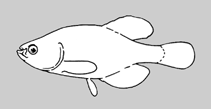
Radios blandos dorsales (total) : 15 - 19; Radios blandos anales: 17 - 22; Vértebra: 24 - 25. Differs from all other species of the genus by possessing 2-4 black spots on posterobasal portion of dorsal fin in males. In addition, it can be separated from all congeners by the unique combination of the following characters: absence of pelvic fin and pelvic girdle; vertebrae 24-25; absence of second pharyngobranchial teeth; absence of ventral process of posttemporal; anal fin with 17-20 rays in females; body depth 33.5-36.0% SL in males; maximum adult size 25.6 mm SL; bright blue bars on flank in males much narrower than interspace; side of head in males with five alternating bright blue and pink to red bars; short postorbital pink strike connecting pink bars 2 and 3; anterior and posterior margins of iris bright blue; dark gray band bordered by a bright blue line on distal margin of dorsal and anal fins, and posterior margin of caudal fin in males; ground color of dorsal and anal fins orange in males; absence of bars on unpaired fins in males; and presence of yellow dots on the caudal fin in males (Ref. 75131).
Body shape (shape guide): short and / or deep.
Inhabits temporary shallow canals (about 50 cm deep) in the floodplains, with light yellow water (Ref. 75131).
Life cycle and mating behavior
Madurez | Reproducción | Puesta | Huevos | Fecundidad | Larva
Costa, W.J.E.M., 2007. Simpsonichthys nigromaculatus, a new miniature seasonal killifish from the upper rio Paraná basin, central Brazil (Teleostei: Cyprinidontiformes: Rivulidae). Ichthyol. Explor. Freshwat. 18(3):199-203. (Ref. 75131)
IUCN Red List Status (Ref. 130435: Version 2025-1)
Threat to humans
Harmless
Human uses
Herramientas
Special reports
Download XML
Fuentes de Internet
Estimates based on models
Phylogenetic diversity index (Referencia
82804): PD
50 = 0.5000 [Uniqueness, from 0.5 = low to 2.0 = high].
Bayesian length-weight: a=0.01995 (0.00906 - 0.04395), b=3.01 (2.83 - 3.19), in cm total length, based on all LWR estimates for this body shape (Ref.
93245).
Nivel trófico (Referencia
69278): 3.1 ±0.4 se; based on size and trophs of closest relatives
Resiliencia (Referencia
120179): Alto, población duplicada en un tiempo mínimo inferior a 15 meses (Preliminary K or Fecundity.).
Fishing Vulnerability (Ref.
59153): Low vulnerability (10 of 100).
🛈