



Etheostoma sitikuense Blanton, 2008
Citico Darter
Carregue seu(sua) Fotos e vídeos
Imagem do Google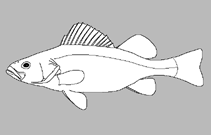 No image available for this species;
drawing shows typical species in Percidae.
Imagem do Google
drawing shows typical species in Percidae.
Classificação / Nomes Nomes comuns | Sinônimos | Catalog of Fishes(Gênero, Espécies) | ITIS | CoL | WoRMS | Cloffa
> Perciformes/Percoidei (Perchs) > Percidae (Perches) > Etheostomatinae
Etymology: Etheostoma: Greek, etheo = to strain + Greek, stoma = mouth; Rafinesque said "various mouths", but Jordan and Evermann suggest the name might have been intended as "Heterostoma (Ref. 45335); sitikuense: The name sitikuense comes from the Cherokee Indian word sitiku for a place of clean fishing water and is the origin for the name of Citico Creek. Citico Darter refers to the type locality of the species, where the only extant, non-introduced.
Etymology: Etheostoma: Greek, etheo = to strain + Greek, stoma = mouth; Rafinesque said "various mouths", but Jordan and Evermann suggest the name might have been intended as "Heterostoma (Ref. 45335); sitikuense: The name sitikuense comes from the Cherokee Indian word sitiku for a place of clean fishing water and is the origin for the name of Citico Creek. Citico Darter refers to the type locality of the species, where the only extant, non-introduced.
Meio ambiente: milieu / Zona climática / intervalo de profundidade / faixa de distribuição Ecologia
; Água doce bentopelágico. Temperate
Distribuição Territórios | Áreas da FAO | Ecossistemas | Ocorrências | Mapa de pontos | Introduções | Faunafri
North America: USA. The Citico Darter occupies an approximately 3.5 river km reach of Citico Creek in Monroe County, Tennessee, just downstream of a U.S. Forest Service boundary. The creek is a tributary of Tellico Lake, an impoundment of the mainstem Little Tennessee River. The population in Citico Creek historically extended further downstream than its current distribution suggests. One individual was collected 13 December, 1979 from lower Citico Creek prior to its inundation by Tellico Lake (D. Etnier, pers. comm.). The darter is historically extirpated from Abrams Creek, a tributary of Chilhowie Lake also impounding the Little Tennessee River, in Great Smoky Mountains National Park, Blount County, Tennessee, where it is known from three specimens collected in 1937 and 1940. This and other at-risk fish species (Jenkins & Burkhead 1984; Simbeck 1990) apparently were extirpated from Abrams Creek by application of rotenone throughout the tributary system below Abrams Falls during 1957, a plan designed to reduce food and habitat competition for a Rainbow Trout fishery (Lennon & Parker 1959). Etheostoma sitikuense has been propagated and reintroduced to lower Abrams Creek, below Abrams Falls and stocked in Tellico River using Citico Creek stocks (Rakes & Shute 2005; Shute et al. 2005; Rakes & Shute 2008). (Ref. 78849).
Tamanho / Peso / Idade
Descrição suscinta Chaves de identificação | Morfologia | Morfometria
Etheostoma sitikuense is distinguished from all members of the E. percnurum species complex by more pored lateral-line scales (34 vs. 28 or fewer); intermediate anal-fin band width (range = 33–39% vs. 49–58% in E. lemniscatum and E. percnurum and 29–33% in E. marmorpinnum); fewer transverse scale rows (15 vs. 16); shorter pectoral (P1L, =240 vs. 245 or greater) and pelvic (P2L, =180 vs. 197 or greater) fins;
and wider (BW, =80 vs. 69 or less), deeper (BD1, =178 vs. 173 or less and BD2, =158 vs. 153 or less) body. E. sitikuense is further distinguished from E. percnurum and E. lemniscatum by narrower distal band on
the second-dorsal fin (range = 9–16% of fin height vs. 23–25%). From E. percnurum and E. marmorpinnum by distal caudal-fin band width (range = 15–18% of fin length vs. 12–15% in E. marmorpinnum and 17–25% in E. percnurum); percentage of area along first-dorsal fin base scaled (70% vs. 20% in E. percnurum and 100% in E. marmorpinnum); and intermediate number of scales around caudal peduncle (24 vs. 23 or 25,
respectively). From E. lemniscatum and E. marmorpinnum by fewer lateral-line scales (43 vs. 44). From E. percnurum by diffuse marbling or stippling in medial portion of second dorsal fin of nuptial males (vs. uniformly dusky); tessellations in medial portion of caudal fin of nuptial males (vs. uniformly dusky); narrower distal band on pectoral fin (range = 14–20% vs. 29–32%); and fewer caudal-fin rays (15 vs. 18); and from E. marmorpinnum by lower percentage of the belly covered by scales (10% vs. 60–80%). Means of other measurements were also informative (Ref. 79849).
Body shape (shape guide): elongated.
Body shape (shape guide): elongated.
Ciclo de vida ou comportamento de acasalamento Maturidade | Reprodução | Desova | Ovos | Fecundidade | Larvas
Referência principal
Carregar suas referências | Referências | Coordenador | Colaboradores
Blanton, R.E. and R.E. Jenkins, 2008. Three new darter species of the Etheostoma percnurum species complex (Percidae, subgenus Catonotus) from the Tennessee and Cumberland river drainages. Zootaxa 1963:1-24. (Ref. 79849)
Status na Lista Vermelha da UICN (Ref. 130435: Version 2025-2 (Global))
Vulnerável (VU) (D2); Date assessed: 20 January 2012
CITES
Not Evaluated
Ameaça para os humanos
Harmless
Uso pelos humanos
FAO - Publication: search | FishSource |
Mais informação
Ecologia Trófica
Itens alimentares (presas)
Composição da dieta
Consumo alimentar
Rações alimentares
Predadores
Itens alimentares (presas)
Composição da dieta
Consumo alimentar
Rações alimentares
Predadores
Ecologia
Ecologia
Ecologia
Dinâmica populacional
Parâmetros de crescimento
Idade máxima / tamanhos
Relação comprimento-peso.
Relação comprimento-comprimento.
Frequências de comprimento
Conversão de massa
Recrutamento
Abundância
Parâmetros de crescimento
Idade máxima / tamanhos
Relação comprimento-peso.
Relação comprimento-comprimento.
Frequências de comprimento
Conversão de massa
Recrutamento
Abundância
Ciclo de vida
Reprodução
Maturidade
Maturidade/Rel. das guelras
Fecundidade
Desova
Agregações de desova
Ovos
Desenvolvimento dos ovos
Larvas
Dinâmica larval
Reprodução
Maturidade
Maturidade/Rel. das guelras
Fecundidade
Desova
Agregações de desova
Ovos
Desenvolvimento dos ovos
Larvas
Dinâmica larval
Anatomia
Área branquial
Cérebro
Otólito
Área branquial
Cérebro
Otólito
Fisiologia
Composição corporal
Nutrientes
Consumo de oxigênio
Tipo de natação
Velocidade de natação
Pigmentos visuais
Som de peixe
Doenças e Parasitas
Toxicidade (LC50s)
Composição corporal
Nutrientes
Consumo de oxigênio
Tipo de natação
Velocidade de natação
Pigmentos visuais
Som de peixe
Doenças e Parasitas
Toxicidade (LC50s)
Genética
genoma
Genética
Heterozigosidade
Hereditariedade
Diversidade genética
genoma
Genética
Heterozigosidade
Hereditariedade
Diversidade genética
Relacionado a humanos
Sistemas de aquicultura
Perfis para aquacultura
Estirpes
Casos de Ciguatera
Selos, moedas, diversos.
Sistemas de aquicultura
Perfis para aquacultura
Estirpes
Casos de Ciguatera
Selos, moedas, diversos.
Ferramentas
Livro eletrônico | Guia de campo | Ferramenta auxiliar de frequências de comprimento | Ferramenta sobre a história de vida | Mapa de pontos |
Catch-MSY |
Relatórios especiais
Checar Manutenção em Aquário | Checar Planilhas de Fatos sobre as Espécies | Checar Planilhas de Fatos sobre Aquicultura
Baixar XML
Fontes da internet
AFORO (otoliths) | Aquatic Commons | BHL | Cloffa | Websites from users | Checar Observador de Peixes (FishWatcher) | CISTI | Catalog of Fishes: Gênero, Espécies | DiscoverLife | ECOTOX | FAO - Publication: search | Faunafri | Fishipedia | Fishtrace | GloBI | Google Books | Google Scholar | Google | IGFA World Record | OneZoom | Open Tree of Life | Otolith Atlas of Taiwan Fishes | PubMed | Reef Life Survey | Socotra Atlas | TreeBase | Árvore da vida | Wikipedia: Ir para, procura | World Records Freshwater Fishing | Zoobank | Registro zoológico
Estimativas baseadas em modelos
Índice de diversidade filogenética (Ref. 82804): PD50 = 0.5000 [Uniqueness, from 0.5 = low to 2.0 = high].
Bayesian length-weight: a=0.00676 (0.00303 - 0.01510), b=3.12 (2.94 - 3.30), in cm total length, based on LWR estimates for this Genus-body shape (Ref. 93245).
Nível Trófico (Ref. 69278): 3.3 ±0.5 se; based on size and trophs of closest relatives
Resiliência (Ref. 120179): Elevada, tempo mínimo de duplicação da população menor que 15 meses (Preliminary K or Fecundity.).