This website uses cookies to enhance your browsing experience and ensure the functionality of our site. For more detailed information about the types of cookies we use and how we protect your privacy, please visit our Privacy Information page.
×
Cookie Settings
This website uses different types of cookies to enhance your experience. Please select your preferences below:
North America: USA. Percina crypta is endemic to the Apalachicola River drainage, where the species occurs in the Flint River system, Georgia, and the Chattahoochee River system, Alabama and Georgia (Ref. 79864).
Dimensione / Peso / Età
Maturità: Lm? range ? - ? cm Max length : 7.3 cm SL maschio/sesso non determinato; (Ref. 79864)
Breve descrizione Chiavi di identificazione | Morfologia | Morfometria
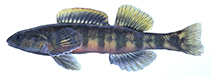
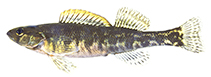
Percina crypta differs from all other described species of Percina in possessing the following combination of characters: branchiostegal membranes slightly connected; preopercular margin non-serrate; premaxillary frenum well-developed; rectangular dorsal saddles usually seven, closely spaced; snout subconical,
subocular bar prominent; and first-dorsal fin with yellow-orange to orange submarginal band in nuptial males and females. Nuptial males lack discrete tubercles, but exhibit tubercular ridges on the anal-fin rays and ventrally on pelvic rays. Lateral blotches rectangular, forming discrete blocks or bars, sometimes conjoined
with dorsal saddles and tapering ventrally. Caudal-fin base with three vertically aligned spots or dashes that enclose two pale areas, middle mark may conjoin with small blotch at caudal base. Percina crypta is most readily distinguished from sympatric P. nigrofasciata in having narrowly separated
dark dorsal saddles, pale inter-saddle width usually less than or rarely equal to saddle width versus pale intersaddle width usually greater than saddle width; width of last two dorsal saddles always greater than pale intersaddle
space versus width of last two dorsal saddles always less than inter-saddle space; usually a single modified scale between the pelvic bases versus two or more scales; and pectoral-fin rays strongly banded versus fins clear or pectoral rays lightly tessellated. Lateral pigmentation highly variable in P. nigrofasciata;
lateral blotches may conjoin with dorsal saddles in large adults and frequently taper ventrally onto lower side; subocular bar variably present; and nuptial males may develop a pale submarginal yellow wash suffused with pale iridescent green in the first-dorsal fin (Ref. 79864). Body shape (shape guide): elongated.
Percina crypta inhabits relatively swiftly flowing areas over bedrock or a mixture of coarse (boulder to gravel) bed sediments (Hill 1996; Marcinek 2003). The species is frequently associated with the aquatic macrophyte Podostemum ceratophyllum (Marcinek 2003). All of our observations of P. crypta have been in shoal habitats, which contrasts markedly with the broader range of stream habitats (pools, runs and riffles) occupied by the co-occurring congener P. nigrofasciata (Ref. 79864). Migratory behaviour is undetermined (Ref. 126106).
Ciclo vitale e comportamento di accoppiamento Maturità | Riproduzione | Deposizione | Uova | Fecondità | Larve
Freeman, M.C., B.J. Freeman, N.M. Burkhead and C.A. Straight, 2008. A new species of Percina (Perciformes: Percidae) from the Apalachicola River drainage, southeastern United States. Zootaxa 1963:25-42. (Ref. 79864)
Stato della Lista Rossa IUCN (Ref. 130435: Version 2025-2 (Global))
Dinamica della popolazione Parametri di crescita Età massima / dimensioni massime Rapporto lunghezza-peso. Lunghezza-lunghezza rel. Lunghezza-frequenze Conversione di massa Reclutamento Abbondanza
Ciclo di vita Riproduzione Maturità Maturità/Gli occhielli sono relativi. Fecondità Deposizione Aggregazioni riproduttive Uova Sviluppo delle uova Larve Dinamica popolazioni larvali
Fisiologia Composizione corporea Nutrienti Consumo di ossigeno Tipo di nuoto Velocità di nuoto Pigmenti visivi Suono del pesce Malattie e parassiti Tossicità (LC50)
Indice di diversità filogenetica (Fonte Biblio. 82804): PD50 = 0.5000 [Uniqueness, from 0.5 = low to 2.0 = high].
Bayesian length-weight: a=0.00575 (0.00268 - 0.01234), b=3.13 (2.95 - 3.31), in cm total length, based on LWR estimates for this (Sub)family-body shape (Ref. 93245).
Livello trofico (Fonte Biblio. 69278): 3.3 ±0.4 se; based on size and trophs of closest relatives
Resilienza (Fonte Biblio. 120179): Alto, tempo minimo di raddoppiamento della popolazione meno di 15 mesi (Preliminary K or Fecundity.).
Vulnerabilità della pesca (Ref. 59153): Low vulnerability (10 of 100). 🛈