Classification / Names
Nombres comunes | Sinónimos | Catalog of Fishes(Género, Especie) | ITIS | CoL | WoRMS | Cloffa
>
Characiformes (Characins) >
Acestrorhamphidae (American tetras) > Acestrorhamphinae
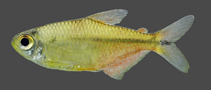
Etymology: Psalidodon: Greek, psalis, -idos = scissors + Greek, odous = teeth (Ref. 45335); vermilion: From the Latin word 'vermiculus' (small worm which yields a red dye), meaning an orangish red pigment, originally derived from the powdered mineral cinnabar. This is in allusion to the red coloration of posterior body portion of this species when alive.
Environment: milieu / climate zone / rango de profundidad / distribution range
Ecología
; agua dulce bentopelágico. Tropical
South America: rio Salgado and rio Almada in Brazil.
Tamaño / Peso / Age
Madurez: Lm ? range ? - ? cm
Max length : 4.3 cm SL macho / no sexado; (Ref. 81202)
Short description
Claves de identificación | Morfología | Morfometría
Radios blandos dorsales (total) : 10 - 11; Radios blandos anales: 23 - 26; Vértebra: 33. Diagnosed from all its congeners from northeastern Brazilian drainages by having distal portion of pelvic fins dark, a combination of sexually dimorphic characters, posteroventral portion of body and fins (except pectoral) reddish in life, and inconspicuous humeral and caudal spots. Can be further distinguished by having the following characters: highest body depth just anterior of dorsal-fin origin, scales on lateral line 32-34; five series of scales between dorsal origin and lateral line; three series of scales between lateral line and pelvic-fin origin; anal fin with 20-23 branched rays; dorsal usually ii,8,i; base of anterior anal-fin rays with 8-12 scales; one or two maxillary teeth; presence of no more than 5 cusps and dentary teeth abruptly decreasing in size posteriorly (Ref. 81202).
Body shape (shape guide): fusiform / normal.
Inhabits clear water streams, running over rocky, pebbles and sand bottom at low altitudes ranging from 188 to 258 m, with slow to moderate water current and less than 1 m deep (Ref. 81202). Stomach contents of three specimens include filamentous algae, fragments of vascular plants and seeds, insects and other unidentified arthropods, and organic debris (Ref. 81202).
Life cycle and mating behavior
Madurez | Reproducción | Puesta | Huevos | Fecundidad | Larva
Zanata, A.M. and P. Camelier, 2009. Astyanax vermilion and Astyanax burgerai: a new characid fishes (Ostariophysi: Characiformes) from Northeastern Bahia, Brazil. Neotrop. Ichthyol. 7(2):175-184. (Ref. 81202)
IUCN Red List Status (Ref. 130435: Version 2025-1)
Threat to humans
Harmless
Human uses
Herramientas
Special reports
Download XML
Fuentes de Internet
Estimates based on models
Phylogenetic diversity index (Referencia
82804): PD
50 = 0.5000 [Uniqueness, from 0.5 = low to 2.0 = high].
Bayesian length-weight: a=0.01096 (0.00493 - 0.02437), b=3.10 (2.93 - 3.27), in cm total length, based on LWR estimates for this Genus-body shape (Ref.
93245).
Nivel trófico (Referencia
69278): 3.0 ±0.3 se; based on size and trophs of closest relatives
Fishing Vulnerability (Ref.
59153): Low vulnerability (10 of 100).
🛈