



Upload your photos and videos
Google image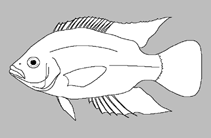 No image available for this species;
drawing shows typical species in Cichlidae.
Google image
drawing shows typical species in Cichlidae.
Classification / Names Common names | Synonyms | Catalog of Fishes(genus, species) | ITIS | CoL | WoRMS | Cloffa
Teleostei (teleosts) > Cichliformes (Cichlids, convict blennies) > Cichlidae (Cichlids) > Geophaginae
Etymology: Geophagus: Greek, gea = the earth + Greek, phagein = to eat (Ref. 45335); sveni: The specific name sveni is a patronym for Sven Kullander, in recognition of his many contributions to Cichlid Systematics (Ref. 84008).
Etymology: Geophagus: Greek, gea = the earth + Greek, phagein = to eat (Ref. 45335); sveni: The specific name sveni is a patronym for Sven Kullander, in recognition of his many contributions to Cichlid Systematics (Ref. 84008).
Environment: milieu / climate zone / depth range / distribution range Ecology
Freshwater; demersal. Tropical; 9°S - 11°S, 48°W - 49°W
Distribution Territories | FAO areas | Ecosystems | Occurrences | Point map | Introductions | Faunafri
South America: Brazil. Known from the middle portions of the Rio Tocantins drainage (Ref. 84008).
Size / Weight / Age
Short description Identification keys | Morphology | Morphometrics
The lack of head markings distinguishes Geophagus sveni from G. grammepareius, G. taeniopareius, G. harreri, G. argyrostictus, and G. gottwaldi which have a complete infra-orbital stripe, and from G. dicrozoster, G. winemilleri, G. brachybranchus, and G. proximus, which have a black preopercular marking. Preserved specimens of Geophagus sveni can be distinguished from all other Geophagus species without head markings (except G. parnaibae) by the possession of five faint vertical, parallel bars on the flank (vs. absent in G. megasema, G. camopiensis and G. altifrons; four in G. surinamensis, and six in G. abalios and G. brokopondo). Geophagus sveni can be distinguished from by its lateral bars (solid bars vs. second and third bars medially bisected by a clearer area, respectively) and the colour pattern of the caudal
fin, which is composed by alternating vertical light and dark bars (vs. alternating horizontal light and dark bars in G. parnaibae). The prominent mid-lateral blotch occupying rostro-caudally five or six scales width and reaching the row immediately above the upper lateral line distinguishes G. sveni from G. abalios, G. surinamensis, G. altifrons, and G. brokopondo. Geophagus sveni can be distinguished from G. camopiensis by the rounded mid-lateral blotch (vs. quadrate-like). Geophagus sveni differs from the sympatric and syntopic Geophagus neambi by the presence of five faint vertically bars (vs. seven or eight conspicuous dorso-ventral bifurcated vertically bars); live specimens with anterior portions of horizontal stripes conspicuously reddish and posterior portions orange (vs. anterior portions slightly more orange than the posterior portions) and three iridescent blue vertical spots present extending along the preopercle (vs. iridescent blue spots absent) (Ref. 84008).
Life cycle and mating behavior Maturity | Reproduction | Spawning | Eggs | Fecundity | Larvae
Main reference
Upload your references | References | Coordinator : Kullander, Sven O. | Collaborators
Lucinda, P.H.F., C.A.S. Lucena and N.C. Assis, 2010. Two new species of cichlid fish genus Geophagus Heckel from the Rio Tocantins drainage (Perciformes: Cichlidae). Zootaxa 2429:29-42. (Ref. 84008)
IUCN Red List Status (Ref. 130435: Version 2025-2 (Global))
Least Concern (LC) ; Date assessed: 07 November 2018
CITES
Not Evaluated
Threat to humans
Harmless
Human uses
FAO - Publication: search | FishSource |
More information
Trophic ecology
Food items (preys)
Diet composition
Food consumption
Food rations
Predators
Food items (preys)
Diet composition
Food consumption
Food rations
Predators
Ecology
Ecology
Ecology
Population dynamics
Growth parameters
Max. ages / sizes
Length-weight rel.
Length-length rel.
Length-frequencies
Mass conversion
Recruitment
Abundance
Growth parameters
Max. ages / sizes
Length-weight rel.
Length-length rel.
Length-frequencies
Mass conversion
Recruitment
Abundance
Life cycle
Reproduction
Maturity
Maturity/Gills rel.
Fecundity
Spawning
Spawning aggregations
Eggs
Egg development
Larvae
Larval dynamics
Reproduction
Maturity
Maturity/Gills rel.
Fecundity
Spawning
Spawning aggregations
Eggs
Egg development
Larvae
Larval dynamics
Anatomy
Gill area
Brain
Otolith
Gill area
Brain
Otolith
Physiology
Body composition
Nutrients
Oxygen consumption
Swimming type
Swimming speed
Visual pigments
Fish sound
Diseases & Parasites
Toxicity (LC50s)
Body composition
Nutrients
Oxygen consumption
Swimming type
Swimming speed
Visual pigments
Fish sound
Diseases & Parasites
Toxicity (LC50s)
Genetics
Genome
Genetics
Heterozygosity
Heritability
Genetic Diversity
Genome
Genetics
Heterozygosity
Heritability
Genetic Diversity
Human related
Aquaculture systems
Aquaculture profiles
Strains
Ciguatera cases
Stamps, coins, misc.
Aquaculture systems
Aquaculture profiles
Strains
Ciguatera cases
Stamps, coins, misc.
Tools
Special reports
Download XML
Internet sources
AFORO (otoliths) | Aquatic Commons | BHL | Cloffa | Websites from users | Check FishWatcher | CISTI | Catalog of Fishes: genus, species | DiscoverLife | ECOTOX | FAO - Publication: search | Faunafri | Fishipedia | Fishtrace | GloBI | Google Books | Google Scholar | Google | IGFA World Record | OneZoom | Open Tree of Life | Otolith Atlas of Taiwan Fishes | PubMed | Reef Life Survey | Socotra Atlas | TreeBase | Tree of Life | Wikipedia: Go, Search | World Records Freshwater Fishing | Zoobank | Zoological Record
Estimates based on models
Phylogenetic diversity index (Ref. 82804): PD50 = 0.5000 [Uniqueness, from 0.5 = low to 2.0 = high].
Bayesian length-weight: a=0.02399 (0.01144 - 0.05029), b=3.01 (2.83 - 3.19), in cm total length, based on LWR estimates for this (Sub)family-body shape (Ref. 93245).
Trophic level (Ref. 69278): 2.3 ±0.1 se; based on size and trophs of closest relatives
Resilience (Ref. 120179): High, minimum population doubling time less than 15 months (Preliminary K or Fecundity.).
Nutrients (Ref. 124155): Calcium = 231 [132, 483] mg/100g; Iron = 2.04 [1.13, 4.05] mg/100g; Protein = 18.6 [17.2, 20.1] %; Omega3 = 0.504 [0.190, 1.422] g/100g; Selenium = 61.2 [26.7, 159.8] μg/100g; VitaminA = 38.2 [9.8, 106.6] μg/100g; Zinc = 2.43 [1.58, 3.82] mg/100g (wet weight);