Holocephali (chimaeras) >
Chimaeriformes (Chimaeras) >
Chimaeridae (Shortnose chimaeras or ratfishes)
Etymology: Chimaera: Named for the mythological creature composed of parts of multiple animals, referring to their odd mix of characteristics (See ETYFish); opalescens: Latin for opalescent, referring to characteristic iridescent coloration of fresh specimens, resembling nacreous colors of the semi-precious stone opal (See ETYFish).
Environment: milieu / climate zone / depth range / distribution range
Ecology
Marine; bathydemersal; depth range 900 - 1408 m (Ref. 87424). Temperate; 57°N - 48°N, 6°W - 11°W
Northeast Atlantic, along the slope to the west of the British Isles and France (Ref. 87424).
Size / Weight / Age
Maturity: Lm ? range ? - ? cm
Max length : 96.8 cm TL male/unsexed; (Ref. 87424); 109.8 cm TL (female)
Short description
Identification keys | Morphology | Morphometrics
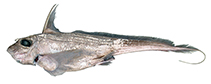
Chimaera opalescens can be distinguished from its congeners by the following combination of characters: body evenly coloured, iridescent, varying from beige to tan in adults and bronzish in juveniles; unpaired fins brown to purple, uniformly coloured or with pale or whitish edges; iris black; claspers tripartite divided for one third of their length, not extending beyond the pelvic fins in adults; dorsal spine equal or shorter than first dorsal fin; ventral caudal lobe equal or deeper than the dorsal caudal lobe. Comparison of DNA sequences of the CO1 gene with those of related species supported C. opalescens as a distinct species (Ref. 87424).
Body shape (shape guide): elongated.
Life cycle and mating behavior
Maturity | Reproduction | Spawning | Eggs | Fecundity | Larvae
Luchetti, E.A., S.P. Iglésias and D.Y. Sellos, 2011. Chimaera opalescens n. sp., a new chimaeroid (Chondrichthyes: Holocephali) from the north-eastern Atlantic Ocean. J. Fish Biol. 79(2):399-417. (Ref. 87424)
IUCN Red List Status (Ref. 130435: Version 2025-2)
Threat to humans
Harmless
Human uses
Tools
Special reports
Download XML
Internet sources