Classification / Names
Nombres comunes | Sinónimos | Catalog of Fishes(Género, Especie) | ITIS | CoL | WoRMS | Cloffa
>
Characiformes (Characins) >
Parodontidae (Scrapetooths)
Etymology: Parodon: Latin, par = two + Latin, dens = teeth (Ref. 45335); magdalenensis: The name magdalenensis refers to the Magdalena River, Colombia, in which this species is endemic (Ref. 88955).
Environment: milieu / climate zone / rango de profundidad / distribution range
Ecología
; agua dulce pelágico. Tropical; 6°N - 4°N, 74°W - 77°W
South America: Colombia. Known from the La Miel River and its tributaries in middle Magdalena drainage, the Paila River system and tributaries of the upper Cauca River, Colombia (Ref. 88955).
Tamaño / Peso / Age
Madurez: Lm ? range ? - ? cm
Max length : 13.2 cm SL macho / no sexado; (Ref. 125980); peso máximo publicado: 49.10 g (Ref. 125980)
Short description
Claves de identificación | Morfología | Morfometría
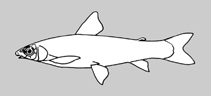
Parodon magdalenensis differs from all congeners by presenting a completely dark ground portion above black lateral stripe that lacks projections or spots extending dorsally, in adults (vs. base color white to yellow above lateral stripe which often has projections or spots extending dorsally); base color below lateral stripe to level of axillary scale gray (vs. body below lateral stripe same color as base color of rest of body, usually white or yellow); adults with well defined black spot from middle of pectoral fin to its tip (not reaching base), absent in juveniles (vs. chromatophores present on pectoral fin not forming well-defined spot, nor bar and often present in juveniles); no dark brown spots on dorsal part of sides above lateral stripe (vs. dark brown spots present); branched pectoralfin rays 11-14 (vs. 14-16; except P. buckleyi which has 13-15 branched pectoral rays). Parodon magdalenensis differs from P. bifasciatus by the higher number of cusps in premaxillary teeth (11-15 vs. 7-12) and the lower number of post-adipose scales (6-8 vs. 7-10, as well as from P. hilarii and P. nasus which have the same count as P. bifasciatus). It is differentiated from P. guyanensis by the number of teeth on the premaxilla (4 vs. 5) and can be distinguished from P. pongoensis and P. moreirai by the presence of a lateral band with projections above and below (vs. absence of projections in such band) and the number of scales in the lateral line (35-38 vs. 40-42 in P. moreirai), and normal sized teeth in the maxilla (vs. teeth minute or absent). It can be distinguished from most P. carrikeri by the number of scales in the lateral line (35-38 vs. 38-39), and the dark coloration along the body including most of the head (vs. ground and general color of body light in P. magdalenensis). It differs from P. suborbitalis by the lower number of cusps in premaxillary teeth (11-15 vs. 15-17) (Ref. 88955).
Life cycle and mating behavior
Madurez | Reproducción | Puesta | Huevos | Fecundidad | Larva
Londoño-Burbano, A., C. Román-Valencia and D.C. Taphorn, 2011. Taxonomic review of Colombian Parodon (Characiformes: Parodontidae), with descriptions of three new species. Neotrop. Ichthyol. 9(4):709-730. (Ref. 88955)
IUCN Red List Status (Ref. 130435: Version 2025-1)
Threat to humans
Harmless
Human uses
Herramientas
Special reports
Download XML
Fuentes de Internet
Estimates based on models
Phylogenetic diversity index (Referencia
82804): PD
50 = 0.5001 [Uniqueness, from 0.5 = low to 2.0 = high].
Bayesian length-weight: a=0.01047 (0.00467 - 0.02349), b=3.07 (2.86 - 3.28), in cm total length, based on LWR estimates for this species & (Sub)family-body (Ref.
93245).
Nivel trófico (Referencia
69278): 2.4 ±0.1 se; based on size and trophs of closest relatives
Resiliencia (Referencia
120179): Medio, población duplicada en un tiempo mínimo de 1.4-4.4 años (Preliminary K or Fecundity.).
Fishing Vulnerability (Ref.
59153): Low vulnerability (10 of 100).
🛈