-

- About this page
- Languages
- User feedbacks
- Citation
- Uploads
-
Related species
- Species in
Satanoperca - Species in
Cichlidae - - Classification -
- Geophaginae
- Cichlidae
- Cichliformes
- Teleostei
- Chordata
- Animalia
- Species in
-



Upload your photos and videos
Google image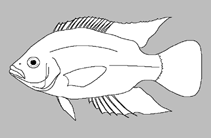 No image available for this species;
drawing shows typical species in Cichlidae.
Google image
drawing shows typical species in Cichlidae.
Classification / Names Common names | Synonyms | Catalog of Fishes(genus, species) | ITIS | CoL | WoRMS | Cloffa
Teleostei (teleosts) > Cichliformes (Cichlids, convict blennies) > Cichlidae (Cichlids) > Geophaginae
Etymology: Satanoperca: Taken from the prince of darkness. Hube liked to name cave fishes with diabolic names based on the idea of hell being underground + Greek, perke = perch (Ref. 45335); rhynchitis: The specific name refers to the long snout of the species and is a substantivated adjective, to be considered as a noun in apposition, formed from the noun rynchos/rhynchos (Greek), snout, and the adjectival suffix itis (Greek), expressing possession.
Eponymy: Named after the devil, and referring in the case of the blindcat to the species’ underground habitat. Günther’s use of a name meaning ‘Satan perch’ for the cichlids was probably inspired by Heckel (q.v.) having named a species as ‘Geophagus daemon’. (Ref. 128868), visit book page.
More on author: Kullander.
Etymology: Satanoperca: Taken from the prince of darkness. Hube liked to name cave fishes with diabolic names based on the idea of hell being underground + Greek, perke = perch (Ref. 45335); rhynchitis: The specific name refers to the long snout of the species and is a substantivated adjective, to be considered as a noun in apposition, formed from the noun rynchos/rhynchos (Greek), snout, and the adjectival suffix itis (Greek), expressing possession.
Eponymy: Named after the devil, and referring in the case of the blindcat to the species’ underground habitat. Günther’s use of a name meaning ‘Satan perch’ for the cichlids was probably inspired by Heckel (q.v.) having named a species as ‘Geophagus daemon’. (Ref. 128868), visit book page.
More on author: Kullander.
Environment: milieu / climate zone / depth range / distribution range Ecology
Freshwater; benthopelagic. Tropical
Distribution Territories | FAO areas | Ecosystems | Occurrences | Point map | Introductions | Faunafri
South America: known only from the Oyapock, Approuague (including Kaw), Kourou, Comté, Iracoubo, and Sinnamary drainages in French Guiana.
Size / Weight / Age
Short description Identification keys | Morphology | Morphometrics
Dorsal spines (total): 14 - 16; Dorsal soft rays (total): 9 - 10; Vertebrae: 27 - 28. Distinguished from Satanoperca daemon, S. lilith, and S. acuticeps in the absence of well defined dark blotches on the side, and lower meristics (soft dorsalfin rays 810, modally 9, vs 12-14; e1 scales 25-27, modally 26, vs 27-31; ceratobranchial gill-rakers 12-14, modally 14, vs 17-23). It is similar to remaining species of the genus, S. jurupari, S. leucosticta, S. mapiritensis, and S. pappaterra in meristics, proportional measurements, dentition, and general colour pattern, but can be diagnosed from all by fewer scales in the e1 row, 25-26, rarely 27, vs 27-28. Differs also from S. pappaterra in the Guaporé and Paraguay river basins in the absence of prominent black blotches along the base of the dorsal fin, and absence of a
welldefined black band along the middle of the side; and from S. leucosticta (Guyana and Suriname), and S. mapiritensis (Orinoco river drainage) by the absence of white spots on the snout and sides of the head. Its most similar species may be S. jurupari in the central Amazon basin from which it differs in modal dorsalfin count XV.9, vs XV.10, e1 scale count 26 vs 27, gill-raker count 13-14 (rarely 15) vs 16-17 (rarely 14, 15, 18), gill blade narrower than ceratobranchial (vs wider), and generally longer snout (14.3-19.4% of SL, vs 11.3-15.9%) (Ref. 90072).
Body shape (shape guide): short and / or deep.
Body shape (shape guide): short and / or deep.
Life cycle and mating behavior Maturity | Reproduction | Spawning | Eggs | Fecundity | Larvae
Main reference
Upload your references | References | Coordinator : Kullander, Sven O. | Collaborators
Kullander, S., 2012. A taxonomic review of Satanoperca (Teleostei: Cichlidae) from French Guiana, South America, with description of a new species. Cybium 36(1):247-262. (Ref. 90072)
IUCN Red List Status (Ref. 130435: Version 2025-2)
Least Concern (LC) ; Date assessed: 17 January 2021
CITES
Not Evaluated
Threat to humans
Harmless
Human uses
FAO - Publication: search | FishSource |
More information
Trophic ecology
Food items (preys)
Diet composition
Food consumption
Food rations
Predators
Food items (preys)
Diet composition
Food consumption
Food rations
Predators
Ecology
Ecology
Ecology
Population dynamics
Growth parameters
Max. ages / sizes
Length-weight rel.
Length-length rel.
Length-frequencies
Mass conversion
Recruitment
Abundance
Growth parameters
Max. ages / sizes
Length-weight rel.
Length-length rel.
Length-frequencies
Mass conversion
Recruitment
Abundance
Life cycle
Reproduction
Maturity
Maturity/Gills rel.
Fecundity
Spawning
Spawning aggregations
Eggs
Egg development
Larvae
Larval dynamics
Reproduction
Maturity
Maturity/Gills rel.
Fecundity
Spawning
Spawning aggregations
Eggs
Egg development
Larvae
Larval dynamics
Anatomy
Gill area
Brain
Otolith
Gill area
Brain
Otolith
Physiology
Body composition
Nutrients
Oxygen consumption
Swimming type
Swimming speed
Visual pigments
Fish sound
Diseases & Parasites
Toxicity (LC50s)
Body composition
Nutrients
Oxygen consumption
Swimming type
Swimming speed
Visual pigments
Fish sound
Diseases & Parasites
Toxicity (LC50s)
Genetics
Genome
Genetics
Heterozygosity
Heritability
Genetic Diversity
Genome
Genetics
Heterozygosity
Heritability
Genetic Diversity
Human related
Aquaculture systems
Aquaculture profiles
Strains
Ciguatera cases
Stamps, coins, misc.
Aquaculture systems
Aquaculture profiles
Strains
Ciguatera cases
Stamps, coins, misc.
Tools
Special reports
Download XML
Internet sources
AFORO (otoliths) | Aquatic Commons | BHL | Cloffa | Websites from users | Check FishWatcher | CISTI | Catalog of Fishes: genus, species | DiscoverLife | ECOTOX | FAO - Publication: search | Faunafri | Fishipedia | Fishtrace | GloBI | Google Books | Google Scholar | Google | IGFA World Record | OneZoom | Open Tree of Life | Otolith Atlas of Taiwan Fishes | PubMed | Reef Life Survey | Socotra Atlas | TreeBase | Tree of Life | Wikipedia: Go, Search | World Records Freshwater Fishing | Zoobank | Zoological Record
Estimates based on models
Phylogenetic diversity index (Ref. 82804): PD50 = 0.5039 [Uniqueness, from 0.5 = low to 2.0 = high].
Bayesian length-weight: a=0.02818 (0.01625 - 0.04888), b=3.01 (2.85 - 3.17), in cm total length, based on LWR estimates for this species & (Sub)family-body (Ref. 93245).
Trophic level (Ref. 69278): 3.1 ±0.4 se; based on size and trophs of closest relatives
Resilience (Ref. 120179): High, minimum population doubling time less than 15 months (Preliminary K or Fecundity.).