



Etheostoma jimmycarter Layman & Mayden, 2012
Bluegrass darter
Hochladen Photos und videos
Google Bild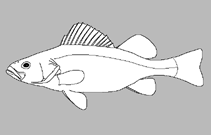 No image available for this species;
drawing shows typical species in Percidae.
Google Bild
drawing shows typical species in Percidae.
Klassifizierung / Names Namen | Synonyme | Catalog of Fishes(Gattung, Arten) | ITIS | CoL | WoRMS | Cloffa
> Perciformes/Percoidei (Perchs) > Percidae (Perches) > Etheostomatinae
Etymology: Etheostoma: Greek, etheo = to strain + Greek, stoma = mouth; Rafinesque said "various mouths", but Jordan and Evermann suggest the name might have been intended as "Heterostoma (Ref. 45335); jimmycarter: Named for President Jimmy Carter, the 39th President of the United States of America, and his environmental leadership and accomplishments in the areas of national energy policy and wilderness protection, and his life-long commitment to social justice and basic human rights; noun in apposition.
Eponymy: James Earl ‘Jimmy’ Carter Jr (b: 1924), the 39th President of the USA and well-known birdwatcher, was honoured for his environmental leadership and accomplishments in the areas of national energy policy and wilderness protection, and his life-long [...] (Ref. 128868), visit book page.
Etymology: Etheostoma: Greek, etheo = to strain + Greek, stoma = mouth; Rafinesque said "various mouths", but Jordan and Evermann suggest the name might have been intended as "Heterostoma (Ref. 45335); jimmycarter: Named for President Jimmy Carter, the 39th President of the United States of America, and his environmental leadership and accomplishments in the areas of national energy policy and wilderness protection, and his life-long commitment to social justice and basic human rights; noun in apposition.
Eponymy: James Earl ‘Jimmy’ Carter Jr (b: 1924), the 39th President of the USA and well-known birdwatcher, was honoured for his environmental leadership and accomplishments in the areas of national energy policy and wilderness protection, and his life-long [...] (Ref. 128868), visit book page.
Umwelt: Milieu / Klimazone / Tiefenbereich / Verbreitungsgebiet Ökologie
; süßwasser benthopelagisch. Temperate
Verbreitung Territorien | FAO Gebiete | Ökosysteme | Vorkommen | Punkt Karte | Einführungen | Faunafri
North America: USA (Green River drainange of Kentucky and Tennessee).
Größe / Gewicht / Alter
Geschlechtsreife: Lm ? range ? - ? cm
Max length : 4.9 cm SL Männchen/unbestimmt; (Ref. 92294); 4.7 cm SL (female)
Max length : 4.9 cm SL Männchen/unbestimmt; (Ref. 92294); 4.7 cm SL (female)
Kurzbeschreibung Bestimmungsschlüssel | Morphologie | Morphometrie
Rückenflossenstacheln (insgesamt) : 11 - 14; Rückenflossenweichstrahlen (insgesamt) : 10 - 13; Afterflossenstacheln: 2; Afterflossenweichstrahlen: 7 - 9. This breeding male of this species, a member of the subgenus Doration, is distinguished by the following characters: spinous dorsal fin with black marginal band, orange medial band, black submedial band interrupted by vertical orange streaks extending from medial band above to basal band, the basal band with bright orange pigment; soft dorsal, caudal, and pectoral fins with distinct bright orange spots on rays; soft dorsal and anal fins without blue pigment; anal fin with many distinct orange spots on rays; the face and lower head tangerine orange with blue on operculum, preoperculum, cheek, and suborbital bar (not on lips and mid-gular region); quadrate lateral blue blotches extend ventrad from lateral line scale row; blue wedge on ventral half of caudal fin base but not developed dorsally. In addition, there is no frenum; incomplete lateral line, unpored scales modally greater than 10 (14); the cheek is usually naked; no palatine teeth; dorsal fin spines modally 12-13; dorsal soft rays modally 11; anal fin soft rays modally 8; pectoral fin rays modally 15; the principal caudal fin rays modally 15; caudal peduncle scales modally 16; preoperculomandibular canal pores modally 10 (Ref. 92294).
Cross section: oval.
Cross section: oval.
Lebenszyklus und Paarungsverhalten Geschlechtsreife | Fortpflanzung | Ablaichen | Eier | Fruchtbarkeit | Larven
Hauptreferenz
Laden Sie Ihre Referenzen hoch | Referenzen | Koordinator | Partner
Layman, S.R. and R.L. Mayden, 2012. Morphological diversity and phylogenetics of the darter subgenus Doration (Percidae: Etheostoma), with descriptions of five new species. Bulletin of the Alabama Museum of Natural History 30:1-83. (Ref. 92294)
CITES
Not Evaluated
Bedrohung für Menschen
Harmless
Nutzung durch Menschen
FAO - Publication: search | FishSource |
Mehr Information
Trophische Ökologie
Lebensmittel (Beutetiere)
Nahrungszusammensetzung
Nahrungsaufnahme
Lebensmittelrationen
Räuber
Lebensmittel (Beutetiere)
Nahrungszusammensetzung
Nahrungsaufnahme
Lebensmittelrationen
Räuber
Ökologie
Ökologie
Ökologie
Populationsdynamik
Wachstumsparameter
Max. Alter/Größen
Länge-Gewicht-Rel.
Länge-Länge-Verhältnis.
Längenhäufigkeiten
Massenkonvertierung
Rekrutierung
Dichte
Wachstumsparameter
Max. Alter/Größen
Länge-Gewicht-Rel.
Länge-Länge-Verhältnis.
Längenhäufigkeiten
Massenkonvertierung
Rekrutierung
Dichte
Lebenszyklus
Fortpflanzung
Geschlechtsreife
Reifung/Kiemen rel.
Fruchtbarkeit
Ablaichen
Laichaggregationen
Eier
Eientwicklung
Larven
Larven Pop.Dyn.
Fortpflanzung
Geschlechtsreife
Reifung/Kiemen rel.
Fruchtbarkeit
Ablaichen
Laichaggregationen
Eier
Eientwicklung
Larven
Larven Pop.Dyn.
Anatomie
Kiemenoberfläche
Gehirn
Otolith
Kiemenoberfläche
Gehirn
Otolith
Physiologie
Körperliche Zusammensetzung
Nährstoffe
Sauerstoffverbrauch
Schwimmart
Schwimmgeschwindigkeit
Visuelle Pigmente
Fischgeräusche
Krankheiten und Parasiten
Toxizität (LC50s)
Körperliche Zusammensetzung
Nährstoffe
Sauerstoffverbrauch
Schwimmart
Schwimmgeschwindigkeit
Visuelle Pigmente
Fischgeräusche
Krankheiten und Parasiten
Toxizität (LC50s)
Genetik
Genom
Genetik
Heterozygotie
Vererbbarkeit
Genetische Vielfalt
Genom
Genetik
Heterozygotie
Vererbbarkeit
Genetische Vielfalt
Menschenbezogen
Aquakultur-Systeme
Aquakultur Profile
Zuchtlinien
Ciguatera-Fälle
Briefmarken, Münzen, Verschiedenes.
Aquakultur-Systeme
Aquakultur Profile
Zuchtlinien
Ciguatera-Fälle
Briefmarken, Münzen, Verschiedenes.
Tools
Zusatzinformationen
Download XML
Zusammenfassung | Punktdaten | Namen | Photos
Internet Quellen
AFORO (otoliths) | Aquatic Commons | BHL | Cloffa | Websites from users | FishWatcher Einträge suchen | CISTI | Catalog of Fishes: Gattung, Arten | DiscoverLife | ECOTOX | FAO - Publication: search | Faunafri | Fishipedia | Fishtrace | GloBI | Google Books | Google Scholar | Google | IGFA World Record | OneZoom | Open Tree of Life | Otolith Atlas of Taiwan Fishes | PubMed | Reef Life Survey | Socotra Atlas | TreeBase | Tree of Life | Wikipedia: Gehe zu, Suchen | World Records Freshwater Fishing | Zoobank | Zoologischer Rekord
Schätzungen auf der Grundlage von Modellen
Phylogenetischer Diversitätsindex (Ref. 82804): PD50 = 0.5000 [Uniqueness, from 0.5 = low to 2.0 = high].
Bayesian length-weight: a=0.00676 (0.00303 - 0.01510), b=3.12 (2.94 - 3.30), in cm total length, based on LWR estimates for this Genus-body shape (Ref. 93245).
Trophische Ebene (Ref. 69278): 3.2 ±0.5 se; based on size and trophs of closest relatives
Widerstandsfähigkeit (Ref. 120179): hoch, Verdopplung der Population dauert weniger als 15 Monate. (Preliminary K or Fecundity.).