



Etheostoma thompsoni Suttkus, Bart & Etnier, 2012
Gumbo darter
Hochladen Photos und videos
Google Bild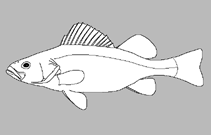 No image available for this species;
drawing shows typical species in Percidae.
Google Bild
drawing shows typical species in Percidae.
Klassifizierung / Names Namen | Synonyme | Catalog of Fishes(Gattung, Arten) | ITIS | CoL | WoRMS | Cloffa
> Perciformes/Percoidei (Perchs) > Percidae (Perches) > Etheostomatinae
Etymology: Etheostoma: Greek, etheo = to strain + Greek, stoma = mouth; Rafinesque said "various mouths", but Jordan and Evermann suggest the name might have been intended as "Heterostoma (Ref. 45335); thompsoni: Named for the the late Bruce Allen Thompson, in recognition of his intense interest in the systematics and biology of darters. His detailed studies of the log perches, wherein he described four new species, were exemplary. His leadership in two extensive papers on Percophidae, A review of Western North Atlantic species of Bembrops, and A revision of Indo-Pacific Bembrops, was commendable.
Eponymy: Dr Bruce Alan Thompson (1946–2007) was an American fisheries biologist, ichthyologist and conservationist. [...] (Ref. 128868), visit book page.
Etymology: Etheostoma: Greek, etheo = to strain + Greek, stoma = mouth; Rafinesque said "various mouths", but Jordan and Evermann suggest the name might have been intended as "Heterostoma (Ref. 45335); thompsoni: Named for the the late Bruce Allen Thompson, in recognition of his intense interest in the systematics and biology of darters. His detailed studies of the log perches, wherein he described four new species, were exemplary. His leadership in two extensive papers on Percophidae, A review of Western North Atlantic species of Bembrops, and A revision of Indo-Pacific Bembrops, was commendable.
Eponymy: Dr Bruce Alan Thompson (1946–2007) was an American fisheries biologist, ichthyologist and conservationist. [...] (Ref. 128868), visit book page.
Umwelt: Milieu / Klimazone / Tiefenbereich / Verbreitungsgebiet Ökologie
; süßwasser benthopelagisch. Subtropical; 11°C - ? (Ref. 93431)
Verbreitung Territorien | FAO Gebiete | Ökosysteme | Vorkommen | Punkt Karte | Einführungen | Faunafri
North America: Neches, Sabine, and Calcasieu river systems in southeastern Texas and southwestern Louisiana, USA.
Größe / Gewicht / Alter
Geschlechtsreife: Lm ? range ? - ? cm
Max length : 5.4 cm SL Männchen/unbestimmt; (Ref. 93431); 6.1 cm SL (female)
Max length : 5.4 cm SL Männchen/unbestimmt; (Ref. 93431); 6.1 cm SL (female)
Kurzbeschreibung Bestimmungsschlüssel | Morphologie | Morphometrie
Rückenflossenstacheln (insgesamt) : 10 - 11; Rückenflossenweichstrahlen (insgesamt) : 12 - 14; Afterflossenstacheln: 2; Afterflossenweichstrahlen: 7 - 8. Belongs to the subgenus Oligocephalus and most closely related to Etheostoma asprigene. Can be distinguished from other members of the of the subgenus Oligocephalus by having the following characters: spinous dorsal fin base is longer in E. thompsoni than in E. asprigene, E. collettei and E. swaini, averaging >30% of standard length in males and females (<30% in in E. asprigene and other Oligocephalus compared) and the transpelvic width is distinctly narrower than in in E. asprigene, E. collettei and E. swaini; nuptial males of E. thompsoni have significantly shorter snouts and caudal peduncles, and narrower bodies than nuptial males of E. asprigene and other Oligocephalus compared. Nuptial males of E. thompsoni also differ from those of E. asprigene in fin and body coloration by having numerous small red blotches or flecks on the sides of body anterior to the dark blue bars that alternate with bright red bars on posterior part of body and caudal peduncle; the central blue-gray band of the spinous dorsal fin is nearly uniform in width (vs. narrow anteriad and progressively widens posteriad in E. asprigene); lateral areas of the belly and between blue bars on the caudal peduncle is a more intense red-orange than in E. asprigene; lastly, naked nape (vs. fully scaled nape in E. asprigene) (Ref. 93431).
Body shape (shape guide): elongated.
Body shape (shape guide): elongated.
Found invariably along the bank, sometimes under cuts, where there were exposed roots with accumulated vegetational debris, and sand to mixed sand and gravel substrate with very little silt. Forms spawning aggregations and spawns in vegetation along the drop-off area close to shore.
Lebenszyklus und Paarungsverhalten Geschlechtsreife | Fortpflanzung | Ablaichen | Eier | Fruchtbarkeit | Larven
Hauptreferenz
Laden Sie Ihre Referenzen hoch | Referenzen | Koordinator | Partner
Suttkus, R.D., H.L., Bart Jr. and D.A. Etnier, 2012. A new darter of the subgenus Oligocephalus, genus Etheostoma, from southeastern Texas and southwestern Louisiana. Tulane Stud. Zool. Bot. 32:6-30. (Ref. 93431)
CITES
Not Evaluated
Bedrohung für Menschen
Harmless
Nutzung durch Menschen
FAO - Publication: search | FishSource |
Mehr Information
Trophische Ökologie
Lebensmittel (Beutetiere)
Nahrungszusammensetzung
Nahrungsaufnahme
Lebensmittelrationen
Räuber
Lebensmittel (Beutetiere)
Nahrungszusammensetzung
Nahrungsaufnahme
Lebensmittelrationen
Räuber
Populationsdynamik
Wachstumsparameter
Max. Alter/Größen
Länge-Gewicht-Rel.
Länge-Länge-Verhältnis.
Längenhäufigkeiten
Massenkonvertierung
Rekrutierung
Dichte
Wachstumsparameter
Max. Alter/Größen
Länge-Gewicht-Rel.
Länge-Länge-Verhältnis.
Längenhäufigkeiten
Massenkonvertierung
Rekrutierung
Dichte
Lebenszyklus
Fortpflanzung
Geschlechtsreife
Reifung/Kiemen rel.
Fruchtbarkeit
Ablaichen
Laichaggregationen
Eier
Eientwicklung
Larven
Larven Pop.Dyn.
Fortpflanzung
Geschlechtsreife
Reifung/Kiemen rel.
Fruchtbarkeit
Ablaichen
Laichaggregationen
Eier
Eientwicklung
Larven
Larven Pop.Dyn.
Anatomie
Kiemenoberfläche
Gehirn
Otolith
Kiemenoberfläche
Gehirn
Otolith
Physiologie
Körperliche Zusammensetzung
Nährstoffe
Sauerstoffverbrauch
Schwimmart
Schwimmgeschwindigkeit
Visuelle Pigmente
Fischgeräusche
Krankheiten und Parasiten
Toxizität (LC50s)
Körperliche Zusammensetzung
Nährstoffe
Sauerstoffverbrauch
Schwimmart
Schwimmgeschwindigkeit
Visuelle Pigmente
Fischgeräusche
Krankheiten und Parasiten
Toxizität (LC50s)
Genetik
Genom
Genetik
Heterozygotie
Vererbbarkeit
Genetische Vielfalt
Genom
Genetik
Heterozygotie
Vererbbarkeit
Genetische Vielfalt
Menschenbezogen
Aquakultur-Systeme
Aquakultur Profile
Zuchtlinien
Ciguatera-Fälle
Briefmarken, Münzen, Verschiedenes.
Aquakultur-Systeme
Aquakultur Profile
Zuchtlinien
Ciguatera-Fälle
Briefmarken, Münzen, Verschiedenes.
Tools
Zusatzinformationen
Download XML
Zusammenfassung | Punktdaten | Namen | Photos
Internet Quellen
AFORO (otoliths) | Aquatic Commons | BHL | Cloffa | Websites from users | FishWatcher Einträge suchen | CISTI | Catalog of Fishes: Gattung, Arten | DiscoverLife | ECOTOX | FAO - Publication: search | Faunafri | Fishipedia | Fishtrace | GloBI | Google Books | Google Scholar | Google | IGFA World Record | OneZoom | Open Tree of Life | Otolith Atlas of Taiwan Fishes | PubMed | Reef Life Survey | Socotra Atlas | TreeBase | Tree of Life | Wikipedia: Gehe zu, Suchen | World Records Freshwater Fishing | Zoobank | Zoologischer Rekord
Schätzungen auf der Grundlage von Modellen
Phylogenetischer Diversitätsindex (Ref. 82804): PD50 = 0.5000 [Uniqueness, from 0.5 = low to 2.0 = high].
Bayesian length-weight: a=0.00676 (0.00303 - 0.01510), b=3.12 (2.94 - 3.30), in cm total length, based on LWR estimates for this Genus-body shape (Ref. 93245).
Trophische Ebene (Ref. 69278): 3.3 ±0.5 se; based on size and trophs of closest relatives
Widerstandsfähigkeit (Ref. 120179): hoch, Verdopplung der Population dauert weniger als 15 Monate. (Preliminary K or Fecundity.).