



Etheostoma thompsoni Suttkus, Bart & Etnier, 2012
Gumbo darter
Carica il tuo foto e Video
Google image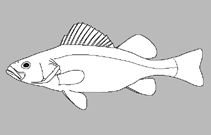 No image available for this species;
drawing shows typical species in Percidae.
Google image
drawing shows typical species in Percidae.
Classificazione / Nomi Nomi Comuni | Sinonimi | Catalog of Fishes(Genere, Specie) | ITIS | CoL | WoRMS | Cloffa
> Perciformes/Percoidei (Perchs) > Percidae (Perches) > Etheostomatinae
Etymology: Etheostoma: Greek, etheo = to strain + Greek, stoma = mouth; Rafinesque said "various mouths", but Jordan and Evermann suggest the name might have been intended as "Heterostoma (Ref. 45335); thompsoni: Named for the the late Bruce Allen Thompson, in recognition of his intense interest in the systematics and biology of darters. His detailed studies of the log perches, wherein he described four new species, were exemplary. His leadership in two extensive papers on Percophidae, A review of Western North Atlantic species of Bembrops, and A revision of Indo-Pacific Bembrops, was commendable.
Eponymy: Dr Bruce Alan Thompson (1946–2007) was an American fisheries biologist, ichthyologist and conservationist. [...] (Ref. 128868), visit book page.
Etymology: Etheostoma: Greek, etheo = to strain + Greek, stoma = mouth; Rafinesque said "various mouths", but Jordan and Evermann suggest the name might have been intended as "Heterostoma (Ref. 45335); thompsoni: Named for the the late Bruce Allen Thompson, in recognition of his intense interest in the systematics and biology of darters. His detailed studies of the log perches, wherein he described four new species, were exemplary. His leadership in two extensive papers on Percophidae, A review of Western North Atlantic species of Bembrops, and A revision of Indo-Pacific Bembrops, was commendable.
Eponymy: Dr Bruce Alan Thompson (1946–2007) was an American fisheries biologist, ichthyologist and conservationist. [...] (Ref. 128868), visit book page.
Ambiente: milieu / zona climatica / distribuzione batimetrica / gamma di distribuzione Ecologia
; acqua dolce benthopelagico. Subtropical; 11°C - ? (Ref. 93431)
Distribuzione Territories | Aree FAO | Ecosistemi | Presenze | Mappa dei ritrovamenti | Introduzioni | Faunafri
North America: Neches, Sabine, and Calcasieu river systems in southeastern Texas and southwestern Louisiana, USA.
Dimensione / Peso / Età
Maturità: Lm ? range ? - ? cm
Max length : 5.4 cm SL maschio/sesso non determinato; (Ref. 93431); 6.1 cm SL (female)
Max length : 5.4 cm SL maschio/sesso non determinato; (Ref. 93431); 6.1 cm SL (female)
Breve descrizione Chiavi di identificazione | Morfologia | Morfometria
Spine dorsali (totale) : 10 - 11; Raggi dorsali molli (totale) : 12 - 14; Spine anali: 2; Raggi anali molli: 7 - 8. Belongs to the subgenus Oligocephalus and most closely related to Etheostoma asprigene. Can be distinguished from other members of the of the subgenus Oligocephalus by having the following characters: spinous dorsal fin base is longer in E. thompsoni than in E. asprigene, E. collettei and E. swaini, averaging >30% of standard length in males and females (<30% in in E. asprigene and other Oligocephalus compared) and the transpelvic width is distinctly narrower than in in E. asprigene, E. collettei and E. swaini; nuptial males of E. thompsoni have significantly shorter snouts and caudal peduncles, and narrower bodies than nuptial males of E. asprigene and other Oligocephalus compared. Nuptial males of E. thompsoni also differ from those of E. asprigene in fin and body coloration by having numerous small red blotches or flecks on the sides of body anterior to the dark blue bars that alternate with bright red bars on posterior part of body and caudal peduncle; the central blue-gray band of the spinous dorsal fin is nearly uniform in width (vs. narrow anteriad and progressively widens posteriad in E. asprigene); lateral areas of the belly and between blue bars on the caudal peduncle is a more intense red-orange than in E. asprigene; lastly, naked nape (vs. fully scaled nape in E. asprigene) (Ref. 93431).
Body shape (shape guide): elongated.
Body shape (shape guide): elongated.
Found invariably along the bank, sometimes under cuts, where there were exposed roots with accumulated vegetational debris, and sand to mixed sand and gravel substrate with very little silt. Forms spawning aggregations and spawns in vegetation along the drop-off area close to shore.
Ciclo vitale e comportamento di accoppiamento Maturità | Riproduzione | Deposizione | Uova | Fecondità | Larve
Riferimento principale
Caricare le referenze | Bibliografia | Coordinatore | Collaboratori
Suttkus, R.D., H.L., Bart Jr. and D.A. Etnier, 2012. A new darter of the subgenus Oligocephalus, genus Etheostoma, from southeastern Texas and southwestern Louisiana. Tulane Stud. Zool. Bot. 32:6-30. (Ref. 93431)
CITES
Not Evaluated
Minaccia per l'uomo
Harmless
Usi umani
FAO - Publication: search | FishSource |
Informazioni ulteriori
Ecologia trofica
Articoli alimentari (prede)
Alimentazione
Consumo di cibo
Razioni alimentari
Predatori
Articoli alimentari (prede)
Alimentazione
Consumo di cibo
Razioni alimentari
Predatori
Dinamica della popolazione
Parametri di crescita
Età massima / dimensioni massime
Rapporto lunghezza-peso.
Lunghezza-lunghezza rel.
Lunghezza-frequenze
Conversione di massa
Reclutamento
Abbondanza
Parametri di crescita
Età massima / dimensioni massime
Rapporto lunghezza-peso.
Lunghezza-lunghezza rel.
Lunghezza-frequenze
Conversione di massa
Reclutamento
Abbondanza
Ciclo di vita
Riproduzione
Maturità
Maturità/Gli occhielli sono relativi.
Fecondità
Deposizione
Aggregazioni riproduttive
Uova
Sviluppo delle uova
Larve
Dinamica popolazioni larvali
Riproduzione
Maturità
Maturità/Gli occhielli sono relativi.
Fecondità
Deposizione
Aggregazioni riproduttive
Uova
Sviluppo delle uova
Larve
Dinamica popolazioni larvali
Anatomia
Area branchiale
Cervello
Otolite
Area branchiale
Cervello
Otolite
Fisiologia
Composizione corporea
Nutrienti
Consumo di ossigeno
Tipo di nuoto
Velocità di nuoto
Pigmenti visivi
Suono del pesce
Malattie e parassiti
Tossicità (LC50)
Composizione corporea
Nutrienti
Consumo di ossigeno
Tipo di nuoto
Velocità di nuoto
Pigmenti visivi
Suono del pesce
Malattie e parassiti
Tossicità (LC50)
Genetica
Genome
Genetica
Eterozigosi
Ereditarietà
Diversità genetica
Genome
Genetica
Eterozigosi
Ereditarietà
Diversità genetica
Legato all'uomo
Sistemi di acquacoltura
Profili di acquacoltura
Varietà
Casi di Ciguatera
Francobolli, monete, materiale vario.
Sistemi di acquacoltura
Profili di acquacoltura
Varietà
Casi di Ciguatera
Francobolli, monete, materiale vario.
Strumenti
Libro elettronico | Giuda pratica | Generatore frequenze di lunghezza | Strumento Parametri Biologici | Mappa dei ritrovamenti |
Cattura-MSY |
Rapporti speciali
Controllo della manutenzione dell'acquario | Verificare la presenza di schede informative sulle specie | Verifica delle schede informative sull'acquacoltura
Scarica XML
Fonti Internet
AFORO (otoliths) | Aquatic Commons | BHL | Cloffa | Websites from users | Check FishWatcher | CISTI | Catalog of Fishes: Genere, Specie | DiscoverLife | ECOTOX | FAO - Publication: search | Faunafri | Fishipedia | Fishtrace | GloBI | Google Books | Google Scholar | Google | IGFA World Record | OneZoom | Open Tree of Life | Otolith Atlas of Taiwan Fishes | PubMed | Reef Life Survey | Socotra Atlas | TreeBase | Tree of Life | Wikipedia: Go, ricerca | World Records Freshwater Fishing | Zoobank | Record zoologico
Stime basate su modelli
Indice di diversità filogenetica (Fonte Biblio. 82804): PD50 = 0.5000 [Uniqueness, from 0.5 = low to 2.0 = high].
Bayesian length-weight: a=0.00676 (0.00303 - 0.01510), b=3.12 (2.94 - 3.30), in cm total length, based on LWR estimates for this Genus-body shape (Ref. 93245).
Livello trofico (Fonte Biblio. 69278): 3.3 ±0.5 se; based on size and trophs of closest relatives
Resilienza (Fonte Biblio. 120179): Alto, tempo minimo di raddoppiamento della popolazione meno di 15 mesi (Preliminary K or Fecundity.).