



Etheostoma thompsoni Suttkus, Bart & Etnier, 2012
Gumbo darter
Carregue seu(sua) Fotos e vídeos
Imagem do Google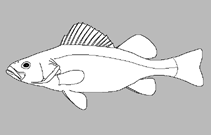 No image available for this species;
drawing shows typical species in Percidae.
Imagem do Google
drawing shows typical species in Percidae.
Classificação / Nomes Nomes comuns | Sinônimos | Catalog of Fishes(Gênero, Espécies) | ITIS | CoL | WoRMS | Cloffa
> Perciformes/Percoidei (Perchs) > Percidae (Perches) > Etheostomatinae
Etymology: Etheostoma: Greek, etheo = to strain + Greek, stoma = mouth; Rafinesque said "various mouths", but Jordan and Evermann suggest the name might have been intended as "Heterostoma (Ref. 45335); thompsoni: Named for the the late Bruce Allen Thompson, in recognition of his intense interest in the systematics and biology of darters. His detailed studies of the log perches, wherein he described four new species, were exemplary. His leadership in two extensive papers on Percophidae, A review of Western North Atlantic species of Bembrops, and A revision of Indo-Pacific Bembrops, was commendable.
Eponymy: Dr Bruce Alan Thompson (1946–2007) was an American fisheries biologist, ichthyologist and conservationist. [...] (Ref. 128868), visit book page.
Etymology: Etheostoma: Greek, etheo = to strain + Greek, stoma = mouth; Rafinesque said "various mouths", but Jordan and Evermann suggest the name might have been intended as "Heterostoma (Ref. 45335); thompsoni: Named for the the late Bruce Allen Thompson, in recognition of his intense interest in the systematics and biology of darters. His detailed studies of the log perches, wherein he described four new species, were exemplary. His leadership in two extensive papers on Percophidae, A review of Western North Atlantic species of Bembrops, and A revision of Indo-Pacific Bembrops, was commendable.
Eponymy: Dr Bruce Alan Thompson (1946–2007) was an American fisheries biologist, ichthyologist and conservationist. [...] (Ref. 128868), visit book page.
Meio ambiente: milieu / Zona climática / intervalo de profundidade / faixa de distribuição Ecologia
; Água doce bentopelágico. Subtropical; 11°C - ? (Ref. 93431)
Distribuição Territórios | Áreas da FAO | Ecossistemas | Ocorrências | Mapa de pontos | Introduções | Faunafri
North America: Neches, Sabine, and Calcasieu river systems in southeastern Texas and southwestern Louisiana, USA.
Tamanho / Peso / Idade
Maturidade: Lm ? range ? - ? cm
Max length : 5.4 cm SL macho/indeterminado; (Ref. 93431); 6.1 cm SL (female)
Max length : 5.4 cm SL macho/indeterminado; (Ref. 93431); 6.1 cm SL (female)
Descrição suscinta Chaves de identificação | Morfologia | Morfometria
Espinhos dorsais (total) : 10 - 11; Raios dorsais (total) : 12 - 14; Espinhos anais: 2; Raios anais : 7 - 8. Belongs to the subgenus Oligocephalus and most closely related to Etheostoma asprigene. Can be distinguished from other members of the of the subgenus Oligocephalus by having the following characters: spinous dorsal fin base is longer in E. thompsoni than in E. asprigene, E. collettei and E. swaini, averaging >30% of standard length in males and females (<30% in in E. asprigene and other Oligocephalus compared) and the transpelvic width is distinctly narrower than in in E. asprigene, E. collettei and E. swaini; nuptial males of E. thompsoni have significantly shorter snouts and caudal peduncles, and narrower bodies than nuptial males of E. asprigene and other Oligocephalus compared. Nuptial males of E. thompsoni also differ from those of E. asprigene in fin and body coloration by having numerous small red blotches or flecks on the sides of body anterior to the dark blue bars that alternate with bright red bars on posterior part of body and caudal peduncle; the central blue-gray band of the spinous dorsal fin is nearly uniform in width (vs. narrow anteriad and progressively widens posteriad in E. asprigene); lateral areas of the belly and between blue bars on the caudal peduncle is a more intense red-orange than in E. asprigene; lastly, naked nape (vs. fully scaled nape in E. asprigene) (Ref. 93431).
Body shape (shape guide): elongated.
Body shape (shape guide): elongated.
Found invariably along the bank, sometimes under cuts, where there were exposed roots with accumulated vegetational debris, and sand to mixed sand and gravel substrate with very little silt. Forms spawning aggregations and spawns in vegetation along the drop-off area close to shore.
Ciclo de vida ou comportamento de acasalamento Maturidade | Reprodução | Desova | Ovos | Fecundidade | Larvas
Referência principal
Carregar suas referências | Referências | Coordenador | Colaboradores
Suttkus, R.D., H.L., Bart Jr. and D.A. Etnier, 2012. A new darter of the subgenus Oligocephalus, genus Etheostoma, from southeastern Texas and southwestern Louisiana. Tulane Stud. Zool. Bot. 32:6-30. (Ref. 93431)
CITES
Not Evaluated
Ameaça para os humanos
Harmless
Uso pelos humanos
FAO - Publication: search | FishSource |
Mais informação
Ecologia Trófica
Itens alimentares (presas)
Composição da dieta
Consumo alimentar
Rações alimentares
Predadores
Itens alimentares (presas)
Composição da dieta
Consumo alimentar
Rações alimentares
Predadores
Dinâmica populacional
Parâmetros de crescimento
Idade máxima / tamanhos
Relação comprimento-peso.
Relação comprimento-comprimento.
Frequências de comprimento
Conversão de massa
Recrutamento
Abundância
Parâmetros de crescimento
Idade máxima / tamanhos
Relação comprimento-peso.
Relação comprimento-comprimento.
Frequências de comprimento
Conversão de massa
Recrutamento
Abundância
Ciclo de vida
Reprodução
Maturidade
Maturidade/Rel. das guelras
Fecundidade
Desova
Agregações de desova
Ovos
Desenvolvimento dos ovos
Larvas
Dinâmica larval
Reprodução
Maturidade
Maturidade/Rel. das guelras
Fecundidade
Desova
Agregações de desova
Ovos
Desenvolvimento dos ovos
Larvas
Dinâmica larval
Anatomia
Área branquial
Cérebro
Otólito
Área branquial
Cérebro
Otólito
Fisiologia
Composição corporal
Nutrientes
Consumo de oxigênio
Tipo de natação
Velocidade de natação
Pigmentos visuais
Som de peixe
Doenças e Parasitas
Toxicidade (LC50s)
Composição corporal
Nutrientes
Consumo de oxigênio
Tipo de natação
Velocidade de natação
Pigmentos visuais
Som de peixe
Doenças e Parasitas
Toxicidade (LC50s)
Genética
genoma
Genética
Heterozigosidade
Hereditariedade
Diversidade genética
genoma
Genética
Heterozigosidade
Hereditariedade
Diversidade genética
Relacionado a humanos
Sistemas de aquicultura
Perfis para aquacultura
Estirpes
Casos de Ciguatera
Selos, moedas, diversos.
Sistemas de aquicultura
Perfis para aquacultura
Estirpes
Casos de Ciguatera
Selos, moedas, diversos.
Ferramentas
Livro eletrônico | Guia de campo | Ferramenta auxiliar de frequências de comprimento | Ferramenta sobre a história de vida | Mapa de pontos |
Catch-MSY |
Relatórios especiais
Checar Manutenção em Aquário | Checar Planilhas de Fatos sobre as Espécies | Checar Planilhas de Fatos sobre Aquicultura
Baixar XML
Fontes da internet
AFORO (otoliths) | Aquatic Commons | BHL | Cloffa | Websites from users | Checar Observador de Peixes (FishWatcher) | CISTI | Catalog of Fishes: Gênero, Espécies | DiscoverLife | ECOTOX | FAO - Publication: search | Faunafri | Fishipedia | Fishtrace | GloBI | Google Books | Google Scholar | Google | IGFA World Record | OneZoom | Open Tree of Life | Otolith Atlas of Taiwan Fishes | PubMed | Reef Life Survey | Socotra Atlas | TreeBase | Árvore da vida | Wikipedia: Ir para, procura | World Records Freshwater Fishing | Zoobank | Registro zoológico
Estimativas baseadas em modelos
Índice de diversidade filogenética (Ref. 82804): PD50 = 0.5000 [Uniqueness, from 0.5 = low to 2.0 = high].
Bayesian length-weight: a=0.00676 (0.00303 - 0.01510), b=3.12 (2.94 - 3.30), in cm total length, based on LWR estimates for this Genus-body shape (Ref. 93245).
Nível Trófico (Ref. 69278): 3.3 ±0.5 se; based on size and trophs of closest relatives
Resiliência (Ref. 120179): Elevada, tempo mínimo de duplicação da população menor que 15 meses (Preliminary K or Fecundity.).