>
Cichliformes (Cichlids, convict blennies) >
Cichlidae (Cichlids) > Pseudocrenilabrinae
Etymology: Haplochromis: Greek, Haploos = single + Greek, chromis = a fish, perhaps a perch (Ref. 45335).
More on author: Boulenger.
Environment: milieu / climate zone / rango de profundidad / distribution range
Ecología
; agua dulce bentopelágico; pH range: 8.0 - 8.0; dH range: 9 - 19. Tropical; 24°C - 26°C (Ref. 2060); 3°N - 3°S
Africa: Lake Victoria and Victoria Nile.
Tamaño / Peso / Age
Madurez: Lm ? range ? - ? cm
Max length : 9.4 cm SL macho / no sexado; (Ref. 4983)
Short description
Claves de identificación | Morfología | Morfometría
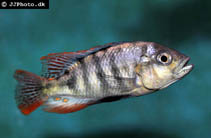
Espinas dorsales (total) : 15 - 16; Radios blandos dorsales (total) : 10 - 9; Espinas anales: 3; Radios blandos anales: 9; Vértebra: 29. Moderately convex dorsal head profile, short snout, terminal mouth and broad bands of contiguously set teeth. Distinguished from males of all species of Neochromis by having enlarged cephalic pores, and large scales on the lateral chest surface, gradually changing to small ones only at the level of the ventral fin insertions. Differs further from N. simotes by having a deeper body (38.4% SL vs. 34.0-35.7), a shorter (26.9% HL vs. 30.8-32.5) and narrower (31.7% HL vs. 35.4-37.7) snout, smaller preorbital depth (14.9% HL vs. 16.8-18.7); larger eyes (30.9% HL vs. 27.1-28.7), a shorter (30.1% HL vs. 30.8-33.1) and narrower (27.7-% HL vs. 32.8-34.4) lower jaw, subequally bicuspid crowns to the teeth in the outer rows, fewer inner tooth rows in both jaws (5), larger scales on the occiput, cycloid scales on the caudal part of the dorsum, larger scales on the chest, and the lack of small cycloid scales on the anal/genital region (Ref. 27668).
Body shape (shape guide): fusiform / normal.
Inhabits rocky and shallow areas of the littoral zone (Ref. 4983). In the lake H. nigricans has been observed to graze on algae from rock surfaces (Ref. 558).
Life cycle and mating behavior
Madurez | Reproducción | Puesta | Huevos | Fecundidad | Larva
Mouthbrooding by females.
Seehausen, O., E. Lippitsch, N. Bouton and H. Zwennes, 1998. Mbipi, the rock-dwelling cichlids of Lake Victoria: description of three new genera and fifteen new species (Teleostei). Ichthyol. Explor. Freshwat. 9(2):129-228. (Ref. 27668)
IUCN Red List Status (Ref. 130435: Version 2025-1)
Threat to humans
Harmless
Human uses
Herramientas
Special reports
Download XML
Fuentes de Internet
Estimates based on models
Phylogenetic diversity index (Referencia
82804): PD
50 = 0.5000 [Uniqueness, from 0.5 = low to 2.0 = high].
Bayesian length-weight: a=0.01445 (0.00674 - 0.03099), b=2.99 (2.82 - 3.16), in cm total length, based on LWR estimates for this (Sub)family-body shape (Ref.
93245).
Nivel trófico (Referencia
69278): 2.2 ±0.1 se; based on diet studies.
Resiliencia (Referencia
120179): Alto, población duplicada en un tiempo mínimo inferior a 15 meses (Preliminary K or Fecundity.).
Fishing Vulnerability (Ref.
59153): Low vulnerability (10 of 100).
🛈