



Onychostoma krongnoense Hoang, Pham & Tran, 2015
Upload your photos and videos
Google image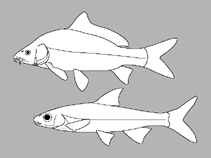 No image available for this species;
drawing shows typical species in Cyprinidae.
Google image
drawing shows typical species in Cyprinidae.
Classification / Names Common names | Synonyms | Catalog of Fishes(genus, species) | ITIS | CoL | WoRMS | Cloffa
Teleostei (teleosts) > Cypriniformes (Carps) > Cyprinidae (Minnows or carps) > Acrossocheilinae
Etymology: Onychostoma: Greek, onyx, -ychos = nail + Greek, stoma = mouth (Ref. 45335); krongnoense: Named in reference to its type locality, upper Krong No drainage.
Etymology: Onychostoma: Greek, onyx, -ychos = nail + Greek, stoma = mouth (Ref. 45335); krongnoense: Named in reference to its type locality, upper Krong No drainage.
Environment: milieu / climate zone / depth range / distribution range Ecology
Freshwater; benthopelagic; pH range: 6.5 - 7.2. Tropical; 17°C - 26°C
Distribution Territories | FAO areas | Ecosystems | Occurrences | Point map | Introductions | Faunafri
Asia: Ea Krong No drainage basin in Vietnam.
Size / Weight / Age
Short description Identification keys | Morphology | Morphometrics
Dorsal soft rays (total): 12; Anal soft rays: 8. Onychostoma krongnoensis can be diagnosed from its congeners by a combination of the following characters: mouth wide (width 1.4?1.6 times in HW); 14-17 predorsal scales; caudal peduncle slender and long (2.5?3.3 times longer than deep); barbels absent in adults and juveniles; dorsal fin with a strong serrated last simple ray; eye diameter small (4.6?5.6 times in HL); and tip of snout with 2?3 irregular transverse rows of 13?46 small and large tubercles (Ref. 102622).
Body shape (shape guide): fusiform / normal.
Body shape (shape guide): fusiform / normal.
Occurs in lotic habitats of main streams with clear water. Prefers erosional zones such as runs and riffles with swift currents over periphyton covering bedrock, large boulders and cobble substrates when foraging. Shoals preferably the depositional zones such as fast flowing pools with detritus and fallen leaves (habitats alternate in rapid succession). Found syntopic with Poropuntius sp., Neolissochilus stracheyi, Annamia normani, Schistura spp., Glyptothorax sp. and Channa gachua. Also shares habitat in the lower reaches of Ea Krong No with Poropuntius sp., Tor spp., Lobocheilus delacouri, Crossocheilus reticulatus, Garra fuliginosa, Garra cambodgiensis, Gyrinocheilus aymonieri, Annamia normani, Schistura spp., and Channa gachua. Feeds on pinnate diatoms (Order Bacillariales) and filamentous algae such Spirogyra sp., Mougeotia sp., and Oedogonium sp. (Ref. 102622).
Life cycle and mating behavior Maturity | Reproduction | Spawning | Eggs | Fecundity | Larvae
Main reference
Upload your references | References | Coordinator | Collaborators
Hoang, H.D., H.M. Pham and N.T. Tran, 2015. Two new species of shovel-jaw carp Onychostoma (Teleostei: Cyprinidae) from southern Vietnam. Zootaxa 3962(1):123-138. (Ref. 102622)
CITES
Not Evaluated
Threat to humans
Harmless
Human uses
Fisheries: commercial
FAO - Publication: search | FishSource |
More information
Trophic ecology
Food items (preys)
Diet composition
Food consumption
Food rations
Predators
Food items (preys)
Diet composition
Food consumption
Food rations
Predators
Population dynamics
Growth parameters
Max. ages / sizes
Length-weight rel.
Length-length rel.
Length-frequencies
Mass conversion
Recruitment
Abundance
Growth parameters
Max. ages / sizes
Length-weight rel.
Length-length rel.
Length-frequencies
Mass conversion
Recruitment
Abundance
Life cycle
Reproduction
Maturity
Maturity/Gills rel.
Fecundity
Spawning
Spawning aggregations
Eggs
Egg development
Larvae
Larval dynamics
Reproduction
Maturity
Maturity/Gills rel.
Fecundity
Spawning
Spawning aggregations
Eggs
Egg development
Larvae
Larval dynamics
Anatomy
Gill area
Brain
Otolith
Gill area
Brain
Otolith
Physiology
Body composition
Nutrients
Oxygen consumption
Swimming type
Swimming speed
Visual pigments
Fish sound
Diseases & Parasites
Toxicity (LC50s)
Body composition
Nutrients
Oxygen consumption
Swimming type
Swimming speed
Visual pigments
Fish sound
Diseases & Parasites
Toxicity (LC50s)
Genetics
Genome
Genetics
Heterozygosity
Heritability
Genetic Diversity
Genome
Genetics
Heterozygosity
Heritability
Genetic Diversity
Human related
Aquaculture systems
Aquaculture profiles
Strains
Ciguatera cases
Stamps, coins, misc.
Aquaculture systems
Aquaculture profiles
Strains
Ciguatera cases
Stamps, coins, misc.
Tools
Special reports
Download XML
Internet sources
AFORO (otoliths) | Aquatic Commons | BHL | Cloffa | Websites from users | Check FishWatcher | CISTI | Catalog of Fishes: genus, species | DiscoverLife | ECOTOX | FAO - Publication: search | Faunafri | Fishipedia | Fishtrace | GloBI | Google Books | Google Scholar | Google | IGFA World Record | OneZoom | Open Tree of Life | Otolith Atlas of Taiwan Fishes | PubMed | Reef Life Survey | Socotra Atlas | TreeBase | Tree of Life | Wikipedia: Go, Search | | Zoological Record
Estimates based on models
|
Phylogenetic diversity index (Ref. 82804) |
PD50 = 0.5000 [Uniqueness, from 0.5 = low to 2.0 = high]. |
| Bayesian length-weight | a=0.00912 (0.00394 - 0.02111), b=3.08 (2.88 - 3.28), in cm total length, based on LWR estimates for this (Sub)family-body shape (Ref. 93245). |
|
Trophic level (Ref. 69278) |
3.0 ±0.3 se; based on size and trophs of closest relatives |
|
Resilience (Ref. 120179) |
High, minimum population doubling time less than 15 months (Preliminary K or Fecundity.). |
|
Fishing Vulnerability (Ref. 59153) |
Low vulnerability (10 of 100). 🛈 |