



Upload your photos and videos
Google image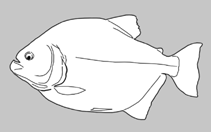 No image available for this species;
drawing shows typical species in Serrasalmidae.
Google image
drawing shows typical species in Serrasalmidae.
Classification / Names Common names | Synonyms | Catalog of Fishes(genus, species) | ITIS | CoL | WoRMS | Cloffa
Teleostei (teleosts) > Characiformes (Characins) > Serrasalmidae (Piranhas and pacus) > Myleinae
Etymology: Myloplus: Greek, mylos, -ou = grey mullet + Greek, plus, ploos = movement of a serpent; zorroi: Named for Mauricio Camargo-Zorro (Instituto Federal de Educação, Ciência e Tecnologia); alludes to the Latin-American fictional character Zorro, because the special features 'masked' this fish as Tometes, concealing its true identity.
Eponymy: Dr Mauricio Camargo-Zorro is a researcher at the Instituto Federal de Educação, Ciência e Tecnologia, São Paulo. [...] (Ref. 128868), visit book page.
Etymology: Myloplus: Greek, mylos, -ou = grey mullet + Greek, plus, ploos = movement of a serpent; zorroi: Named for Mauricio Camargo-Zorro (Instituto Federal de Educação, Ciência e Tecnologia); alludes to the Latin-American fictional character Zorro, because the special features 'masked' this fish as Tometes, concealing its true identity.
Eponymy: Dr Mauricio Camargo-Zorro is a researcher at the Instituto Federal de Educação, Ciência e Tecnologia, São Paulo. [...] (Ref. 128868), visit book page.
Environment: milieu / climate zone / depth range / distribution range Ecology
Freshwater; benthopelagic. Tropical
Distribution Territories | FAO areas | Ecosystems | Occurrences | Point map | Introductions | Faunafri
South America: Brazil.
Size / Weight / Age
Short description Identification keys | Morphology | Morphometrics
This species is distinguished from its congeners by the following characters: absence of the abdominal keel and prepelvic serrae formed by 13-19 low spines (vs. a well-marked abdominal keel and prepelvic serrae of more than 20 high spines). It differs from asterias, levis, torquatus by having fewer branched dorsal-fin rays 20-22 (vs. 23 or more); from arnoldi, ternetzi, torquatus by having a greater number of branched anal-fin rays 32-34 (vs. 31 or fewer); differs significantly from lobatus, schomburgkii, rhomboidalis by having two rows of premaxillary teeth forming a slight arc (vs. 2 rows of premaxillary teeth forming a shape that resembles the uppercase letter 'A'; shorter dorsal-fin base 27.6-30.1% of SL (vs. 31.8% of SL or higher); differs from asterias, levis, ternetzi, torquatus in having a larger interdorsal distance 11.4-12.7% of SL (vs. 10.8% of SL or lower); differs further from M. ternetzi by the presence of a pair of symphyseal teeth (vs. none); from asterias, levis, lobatus, ternetzi by having a smaller vertical diameter of the eye 27.3-35.4% of HL (vs. 35.5% of HL or greater); from arnoldi, torquatus by having a greater number of total vertebrae 40-41 (vs. 37 or less), by having anterior dorsal-fin rays lacking pigmentation (vs. strongly dark pigmented), and the presence of a diffuse dark band at caudal-fin distal border (vs. the presence of a well-defined dark band); from M. asterias by having an elongated fontanel with similarly sized anterior and posterior portions (vs. very short posterior fontanel and rounded anterior fontanel) (Ref. 114773).
Body shape (shape guide): short and / or deep; Cross section: compressed.
Body shape (shape guide): short and / or deep; Cross section: compressed.
Life cycle and mating behavior Maturity | Reproduction | Spawning | Eggs | Fecundity | Larvae
Main reference
Upload your references | References | Coordinator | Collaborators
Andrade, M.C., M. Jégu and T. Giarrizzo, 2016. A new large species of Myloplus (Characiformes: Serrasalmidae) from rio Madeira basin, Brazil. ZooKeys 571:153-167. (Ref. 114773)
CITES
Not Evaluated
Threat to humans
Harmless
Human uses
FAO - Publication: search | FishSource |
More information
Trophic ecology
Food items (preys)
Diet composition
Food consumption
Food rations
Predators
Food items (preys)
Diet composition
Food consumption
Food rations
Predators
Ecology
Ecology
Ecology
Population dynamics
Growth parameters
Max. ages / sizes
Length-weight rel.
Length-length rel.
Length-frequencies
Mass conversion
Recruitment
Abundance
Growth parameters
Max. ages / sizes
Length-weight rel.
Length-length rel.
Length-frequencies
Mass conversion
Recruitment
Abundance
Life cycle
Reproduction
Maturity
Maturity/Gills rel.
Fecundity
Spawning
Spawning aggregations
Eggs
Egg development
Larvae
Larval dynamics
Reproduction
Maturity
Maturity/Gills rel.
Fecundity
Spawning
Spawning aggregations
Eggs
Egg development
Larvae
Larval dynamics
Anatomy
Gill area
Brain
Otolith
Gill area
Brain
Otolith
Physiology
Body composition
Nutrients
Oxygen consumption
Swimming type
Swimming speed
Visual pigments
Fish sound
Diseases & Parasites
Toxicity (LC50s)
Body composition
Nutrients
Oxygen consumption
Swimming type
Swimming speed
Visual pigments
Fish sound
Diseases & Parasites
Toxicity (LC50s)
Genetics
Genome
Genetics
Heterozygosity
Heritability
Genetic Diversity
Genome
Genetics
Heterozygosity
Heritability
Genetic Diversity
Human related
Aquaculture systems
Aquaculture profiles
Strains
Ciguatera cases
Stamps, coins, misc.
Aquaculture systems
Aquaculture profiles
Strains
Ciguatera cases
Stamps, coins, misc.
Tools
Special reports
Download XML
Internet sources
AFORO (otoliths) | Aquatic Commons | BHL | Cloffa | Websites from users | Check FishWatcher | CISTI | Catalog of Fishes: genus, species | DiscoverLife | ECOTOX | FAO - Publication: search | Faunafri | Fishipedia | Fishtrace | GloBI | Google Books | Google Scholar | Google | IGFA World Record | OneZoom | Open Tree of Life | Otolith Atlas of Taiwan Fishes | PubMed | Reef Life Survey | Socotra Atlas | TreeBase | Tree of Life | Wikipedia: Go, Search | World Records Freshwater Fishing | Zoobank | Zoological Record
Estimates based on models
Phylogenetic diversity index (Ref. 82804): PD50 = 0.5001 [Uniqueness, from 0.5 = low to 2.0 = high].
Bayesian length-weight: a=0.02754 (0.01332 - 0.05696), b=2.96 (2.78 - 3.14), in cm total length, based on LWR estimates for this Genus-body shape (Ref. 93245).
Resilience (Ref. 120179): High, minimum population doubling time less than 15 months (Preliminary K or Fecundity.).