Classification / Names
Κοινά ονόματα | Συνώνυμα | Catalog of Fishes(Γένος, Είδη) | ITIS | CoL | WoRMS | Cloffa
>
Siluriformes (Catfishes) >
Trichomycteridae (Pencil or parasitic catfishes) > Tridentinae
Etymology: Potamoglanis: Derived from the Greek potamo, means river; the gods of rivers in the Greek mythology, and from glanis, means catfish; wapixana: The wapixana refers to a native tribe from the Serra da Lua region in western Roraima state, northern Brazil. This native tribe has occupied this region for, at least, three centuries. The new species was mainly collected in the villages of Cantá and Bonfim situated in this region. The Wapixana tribe was under oppression by other native tribes and by colonizers, fact that contributed for a huge cultural loss (Ref. 116786).
Eponymy: The Wapisâna (also given as Wapishana, Wapisiana or Wapixana) are an Amerindian tribe who inhabit the region in northern Brazil where these species occur. [...] (Ref. 128868), visit book page.
Environment: milieu / climate zone / εύρος βάθους / distribution range
Οικολογία
; Γλυκού νερού βενθικό(ς). Tropical
South America: Branco and Negro river drainages, Amazonas river basin in Brazil.
Μέγεθος / Βάρος / Age
Γεννητική Ωρίμανση: Lm ? range ? - ? cm
Max length : 1.6 cm SL αρσενικό/απροσδιόριστο; (Ref. 116786)
Short description
Κλείδες προσδιορισμού | Μορφολογία | Μορφομετρία
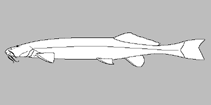
Μαλακές ραχιαίες ακτίνες (συνολικά) : 7 - 8; Μαλακές εδρικές ακτίνες: 7; Σπόνδυλοι: 34 - 36. Trichomycterus wapixana is distinguished from all congeners of Trichomycterus hasemani group by having 34 to 36 vertebrae (vs. 32 in T. hasemani and T. johnsoni, 29 to 32 in T. anhanga) and anal-fin origin in a vertical through the base of the 20th, 21st or 22nd vertebra (vs. 18th in T. hasemani, 17th in T. johnsoni and 16th in T. anhanga). It differs from T. hasemani and T. johnsoni by having the origin of the pelvic fin in a vertical between the base of 15th and 17th vertebrae (vs. 14th in T. hasemani and 13th in T. johnsoni) and a dark spot on the middle of the lower lip (vs. absent). It is distinguished from T. anhanga by having pelvic fins and girdle (vs. absent), 10 to 11 dorsal procurrent rays in the caudal fin (vs. 6 to 8), 9 to 12 ventral procurrent rays in the caudal fin (vs. 6 to 7), seven (ii +5 or iii + 4) anal-fin rays (vs. ii + 4), five (i + 4 or ii + 3) pectoral fin rays (vs. i + 2), dorsal-fin origin at vertical through the base of the 20th, 21st or 22nd vertebra (vs. 16th or 17th), 6 branchiostegal rays (vs. 4 or 5), two pairs of pleural ribs on first two vertebrae posterior to Weberian Complex (vs. single pair), a series of dark brown spots in the lateral midline of the body (vs. absent), broad palatine (vs. narrow, comma-shaped palatine), and parasphenoid present (vs. absent). It can be separated further from T. johnsoni by the origin of the urogenital pore in a vertical between the base of the 17th and 19th vertebrae (vs. 15th) (Ref. 116786).
Body shape (shape guide): elongated.
Found in marginal vegetation of small streams (Ref. 116750).
Life cycle and mating behavior
Γεννητική Ωρίμανση | Αναπαραγωγή | Γεννοβολία | Αβγά | Γονιμότητα | Προνύμφες
Henschel, E., J.L.O. Mattos, A.M. Katz and W.J.E.M. Costa, 2018. Position of enigmatic miniature trichomycterid catfishes inferred from molecular data (Siluriformes). Zoologica Scripta 2017:1-10. (Ref. 116750)
IUCN Red List Status (Ref. 130435: Version 2025-1)
Threat to humans
Harmless
Human uses
αλιεία: χωρίς ενδιαφέρον
Εργαλεία
Special reports
Download XML
Διαδικτυακές πηγές
Estimates based on models
Phylogenetic diversity index (Αναφ.
82804): PD
50 = 0.5625 [Uniqueness, from 0.5 = low to 2.0 = high].
Bayesian length-weight: a=0.00389 (0.00180 - 0.00842), b=3.12 (2.94 - 3.30), in cm total length, based on all LWR estimates for this body shape (Ref.
93245).
Τροφικό Επίπεδο (Αναφ.
69278): 3.0 ±0.3 se; based on size and trophs of closest relatives
Fishing Vulnerability (Ref.
59153): Low vulnerability (10 of 100).
🛈