Classification / Names
Nomi Comuni | Sinonimi | Catalog of Fishes(Genere, Specie) | ITIS | CoL | WoRMS | Cloffa
>
Dactylopteriformes (Flying gurnards) >
Pegasidae (Seamoths)
Etymology: Pegasus: Named after the winged horse sprung from the blood of Medusa (Ref. 1418).
Environment: milieu / climate zone / distribuzione batimetrica / distribution range
Ecologia
marino batidemersale; distribuzione batimetrica 10 - 45 m (Ref. 117113). Tropical
Western Pacific: Australia.
Size / Peso / Age
Maturità: Lm ? range ? - ? cm
Max length : 9.8 cm SL maschio/sesso non determinato; (Ref. 117113)
Short description
Chiavi di identificazione | Morfologia | Morfometria
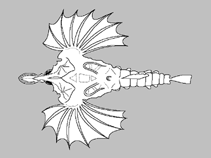
Raggi dorsali molli (totale) : 5; Raggi anali molli: 5. This species is distinguished by the following characters: 12 tail rings with the anteriormost 9 mobile, articulating laterally, and remaining 3 are fused together, attenuated and dorsoventrally flattened; terminodorsal-lateral (tdl) and terminoventral-lateral (tvl) plates each with an anteriorly and posteriorly directed spine; no terminal-lateral plates (tl); with interpectoral plate (ip); with a single ventral preopercular notch; spatulate rostrum; carapace with 3 small posteriorly directed tubercles along each of the dorsal ridge, one at the centre of each dorsal plate; no scales on orbit; pectoral-fin soft rays 9-10 (usually 10), the 5th ray stouter than other rays; 7 abdominal centra, 14 caudal centra, 21 total centra; 4 dark saddles on tail and without dark saddle on tail ring XI (Ref. 117113).
Body shape (shape guide): elongated; Cross section: flattened.
Life cycle and mating behavior
Maturità | Riproduzione | Deposizione | Uova | Fecundity | Larve
Osterhage, D., J.J. Pogonoski, S.A. Appleyard and W.T. White, 2016. Integrated taxonomy reveals hidden diversity in northern Australian fishes: A new species of seamoth (Genus Pegasus). PLoS ONE 11(3):e0149415. doi:10.1371/journal.pone.0149415 (Ref. 117113)
IUCN Red List Status (Ref. 130435: Version 2025-1)
Threat to humans
Harmless
Human uses
Pesca: di potenziale interesse
Strumenti
Special reports
Download XML
Fonti Internet
Estimates based on models
Phylogenetic diversity index (Fonte Biblio.
82804): PD
50 = 0.5391 [Uniqueness, from 0.5 = low to 2.0 = high].
Bayesian length-weight: a=0.01000 (0.00244 - 0.04107), b=3.04 (2.81 - 3.27), in cm total length, based on all LWR estimates for this body shape (Ref.
93245).
Trophic level (Fonte Biblio.
69278): 3.3 ±0.4 se; based on size and trophs of closest relatives
Fishing Vulnerability (Ref.
59153): Low vulnerability (10 of 100).
🛈