Classification / Names
Nombres comunes | Sinónimos | Catalog of Fishes(Género, Especie) | ITIS | CoL | WoRMS | Cloffa
>
Cypriniformes (Carps) >
Nemacheilidae (Brook loaches)
Etymology: Homatula: Greek, homos, homoios = similar + Greek, atylos, atylotos = without callosities; anteridorsalis: Name from Latin 'anteri' meaning 'in front' and 'dorsalis' for dorsal fin, referring to the more anterior origin of dorsal- and pelvic-fins than in other species of Homatula.
Environment: milieu / climate zone / rango de profundidad / distribution range
Ecología
; agua dulce demersal. Subtropical
Asia: China.
Tamaño / Peso / Age
Madurez: Lm ? range ? - ? cm
Max length : 14.1 cm SL macho / no sexado; (Ref. 121600)
Short description
Claves de identificación | Morfología | Morfometría
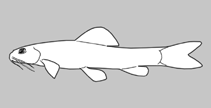
This species is distinguished from its congeners by the following set of characters: with bars on flank across lateral line more than or equal to 25 (vs. less than or equal to 20 in H. acuticephala, H. erhaiensis); bars on flank vertical along lateral line (vs. none in H. nigra); no free protrusions between the pelvic fins (vs. pair of free protrusions in H. pycnolepis); gill opening is smaller, upper angle level with lower edge of eye (vs. opening larger and with upper angle aligned with middle point of eye in H. acuticephala, H. anguillioides, H. coccinocola, H. erhaiensis, H. pycnolepis); with pelvic axillary lobe (vs. none in H. anguillioides, H. acuticephala); marked notch on lower jaw (vs. lower jaw spoon-shaped and no notch in H. erhaiensis, H. wuliangensis); dorsal-fin base is shorter than longest branched dorsal-fin ray (vs. longer than longest branched dorsal-fin ray in H. acuticephala, H. anguillioides, H. cryptoclathrata, H. erhaiensis, H. wuliangensis); dorsal and pelvic fins are located anteriorly, predorsal length 44.4% SL (42.8-46.3%), prepelvic length 45% SL (43.3-46.7 %) (vs. predorsal length 47.7% SL (45.7-49.6 %), prepelvic length 48.7% SL (47.0-49.9 %) in all congeners of densely-scaled group of Homatula (Ref. 121600).
Cross section: circular.
Inhabits flowing and clear stream environments and dwells on the bottom, shuttling back and forth among rocks and gravel. An omnivorous species, mainly feeding on algae attached to rocks, organic residues, and small aquatic insects. It inhabits flowing and clear stream environments and dwells on the bottom, shuttling back and forth among rocks and gravel (Ref. 121600).
Life cycle and mating behavior
Madurez | Reproducción | Puesta | Huevos | Fecundidad | Larva
Li, X., X.-J. Che and W. Zhou, 2019. Loaches of Homatula (Teleostei: Nemacheilidae) from the upper Salween River in Yunnan, China with description of three new species. Zootaxa 4711(2):330-348. (Ref. 121600)
IUCN Red List Status (Ref. 130435: Version 2025-1)
Threat to humans
Harmless
Human uses
Herramientas
Special reports
Download XML
Fuentes de Internet
Estimates based on models
Phylogenetic diversity index (Referencia
82804): PD
50 = 0.5000 [Uniqueness, from 0.5 = low to 2.0 = high].
Bayesian length-weight: a=0.00724 (0.00347 - 0.01512), b=3.01 (2.83 - 3.19), in cm total length, based on LWR estimates for this (Sub)family-body shape (Ref.
93245).
Nivel trófico (Referencia
69278): 2.7 ±0.3 se; based on size and trophs of closest relatives
Resiliencia (Referencia
120179): Medio, población duplicada en un tiempo mínimo de 1.4-4.4 años (Preliminary K or Fecundity.).
Fishing Vulnerability (Ref.
59153): Low vulnerability (10 of 100).
🛈